
Nobody pays for an inspection. They pay for the report, the document that lands in an inbox, gets forwarded to a contractor, is argued over at a meeting and, occasionally, is read out in a dispute two years later. The visit is an hour; the report is what survives it. This guide is the complete structure of that document, from the cover to the sign-off, with two worked examples taken from a real report at the end.

It applies equally to a snagging report on a new home, a punch list on a commercial fit-out, a condition report on a rental and a defect schedule issued by an architect. The vocabulary changes with the country and the contract; the structure does not. If you need the regional terms, punch list versus snag list has them.
What an inspection report is for
A report has three readers, and they want different things from it. The client wants to know how bad it is and what happens next, and will read the summary and the photographs. The contractor wants a list they can price and work from, and will read the items and nothing else. The third party: a warranty provider, a lawyer, an adjudicator, wants to know whether the report is evidence, and will read the scope, the dates and the declaration.
Every structural decision below follows from that. The summary exists for the client. The items are written for the contractor. The scope, the evidence rules and the sign-off exist for the reader who was not there.
The eight sections of a report that gets acted on
Most reports that fail do so because one of these is missing, and it is usually the second or the sixth.
| Section | What it contains | Who it is for |
|---|---|---|
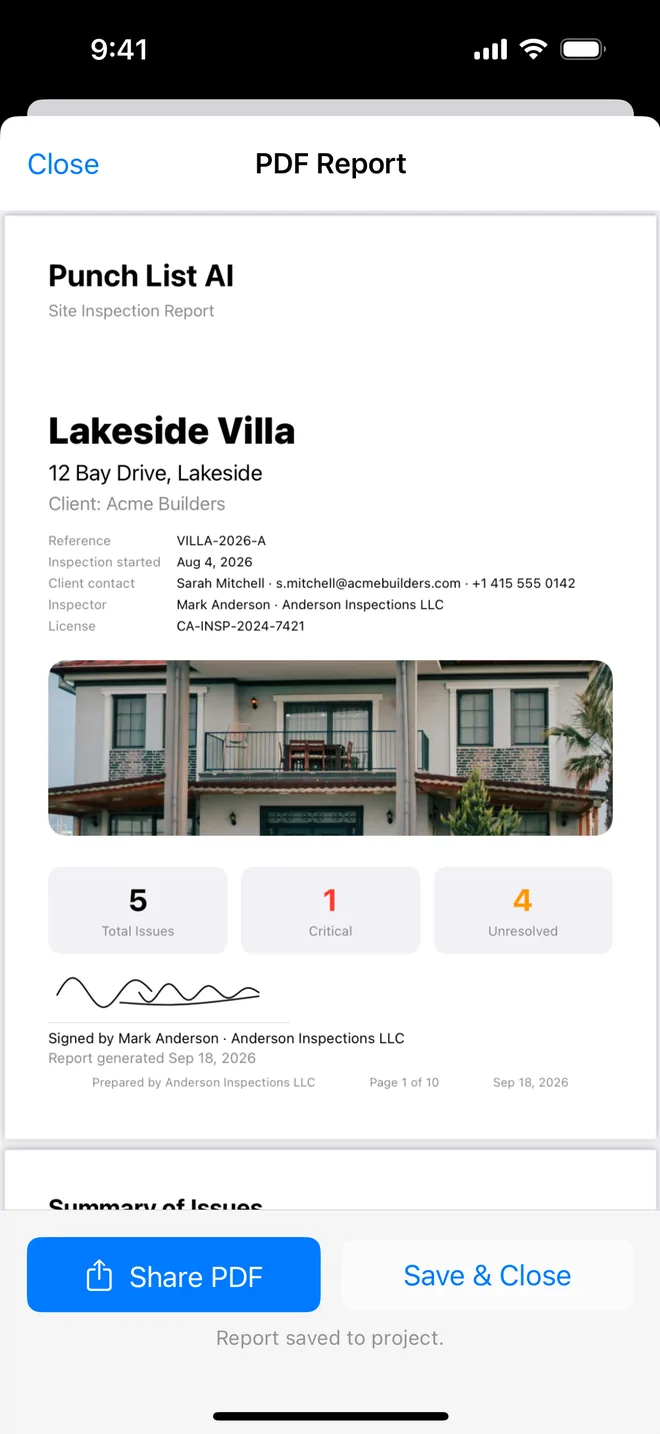
| 1. Cover | Project or property name and address; client and their contact; inspector, company and licence or accreditation where one exists; the reference number; the inspection date and the date of issue; the report version. | Everyone. If the cover is wrong, nothing after it is trusted. |
| 2. Scope and limitations | What was inspected and how (visual, non-intrusive, from ground level, unfurnished); what was not (roof void not accessed, services not tested, external areas in darkness); the weather and conditions on the day. | The third party. This paragraph is what makes the report defensible. |
| 3. Summary | Item counts by severity, the three or four findings that matter most in plain language, and the overall recommendation (complete, proceed with conditions, do not complete). | The client, who may read nothing else. |
| 4. Items | One entry per defect: reference, location, description, photographs, severity, trade, action, priority and due date. Grouped by area or by trade, numbered so nothing can be renumbered later. | The contractor. |
| 5. Schedule | The items as a table on one or two pages: reference, location, short description, severity, trade, status. This is the page the contractor prints. | The contractor's site manager. |
| 6. Declaration and sign-off | Who inspected, in what capacity, a statement that the findings reflect the condition observed on the date, the author's name and signature, and any professional disclaimers required by the inspector's body or insurer. | The third party and the client. |
| 7. Distribution | Who received the report and when. Version history if it has been reissued. | Everyone, later, when someone claims they never had it. |
| 8. Re-inspection record | On a follow-up: every original item with its new status (closed, open, disputed), a new photograph for closed items, and any new items found. | The client and whoever is holding the retention. |
Sections one, four and six are non-negotiable on every report. Two and seven are what separate a professional report from a list. Five is a courtesy that halves the number of phone calls. Eight only exists after the first visit but should be planned for from the start: if the item numbering changes between visits, the re-inspection record becomes impossible.
How do you write a defect item?
An item is the unit of the report and the unit of the argument. Each one answers four questions in a fixed order: where, what, how serious, what to do. The defect report guide covers the wording in depth; the short version is here because everything else depends on it.
- Reference. Project code and a sequential number, assigned once and never reused:
VILLA-2026-A-003. A reference that survives the project is worth more than any other field. - Location. Precise enough to walk to without asking: "Bathroom 2, first floor, wall behind WC" rather than "bathroom". On larger buildings, level and grid or room number.
- Description. What is observed, with extent as a number: "diagonal crack, approx. 350 mm, widest 1.5 mm, running from top-left corner of door frame". Observation, not diagnosis, unless you are qualified to diagnose and are prepared to sign for it.
- Photographs. One that locates, one that shows. More if the defect has a cause visible elsewhere (the cill for the render crack, the shower above for the ceiling stain).
- Severity. A band from a scale defined once in the scope section. Four bands are enough; five invites debate about the boundaries.
- Trade. Who fixes it. This is what lets the contractor sort the schedule and send each subcontractor their own pages.
- Action. An instruction, not an observation: "rake out and re-seal internal corner with sanitary silicone", not "sealant defective".
- Priority and due date. When it must be done, tied to the contract where possible: before completion, within the 14-day rectification period, within the defects period.
The field list, with what to leave out and why, is in the punch list template guide; the defect field guide has a "record it" line for forty common defects that follows exactly this shape.
What counts as evidence?
A description is an opinion. A photograph with a date, a location and a scale is a record. The difference matters at the moment the contractor says "that was not there when we left", and it is decided by what you did on site months earlier.
Two photographs per item. The first is taken from far enough away that the room or elevation is recognisable: the door, the window, the fixed feature that puts the defect somewhere. The second is close enough to show the defect itself. A close-up alone could be any wall in any building; a wide shot alone shows nothing.
Scale in the frame. A tape, a crack gauge, a coin, a hand. Without it, "350 mm crack" is a number in a document; with it, the number can be checked by anyone looking at the photograph.
Light from the side. Finishing defects: lipping, undulation, poor filling, brush marks, vanish under flat light and appear under raking light. Stand so a window or a torch lights the surface at a low angle, and say in the scope that finishes were viewed in raking light.
Markup that does not destroy the original. A circle around the defect and an arrow to the water path help every reader. Draw them on a copy, or in a tool that keeps the annotation on a separate layer, so the unmarked original exists if it is ever needed.
The date and the device. Photographs taken on a phone carry a timestamp in the file. Reports generated from the same photographs carry the inspection date on every page. Between them, the question "when was this taken" has a boring answer, which is the point.
What not to rely on. A photograph of a moisture meter is not a moisture reading; write the number and the meter type in the item. A photograph through glass is rarely usable. A photograph taken after the contractor has started the repair is not evidence of the defect; it is evidence that the repair was started.
Severity, priority and due dates
These are three different fields and reports that merge them generate arguments. Severity is how bad the defect is, judged by consequence: low (cosmetic), medium (functional, or will worsen), high (safety, water or compliance), critical (stop, isolate, do not occupy). Priority is the order of work, which is a decision the client makes with the severity in front of them. Due date is when the contract says it must be done.
A low-severity defect can be high priority (the scratch on the reception desk the client's chairman will see on Monday) and a high-severity defect can have a long due date (the cavity tray that needs scaffolding, in the defects period rather than before completion). Keeping the three separate is what lets the report be honest about the first without misrepresenting the second.
Define the severity scale once, in the scope section, in a sentence per band. Do not define priority; it is the client's. Tie due dates to contract terms, "before practical completion", "within the rectification period", "within the defects liability period", rather than to calendar dates that shift.
Sign-off, distribution and closing the report
A report is issued, not sent. That means a version, a date of issue, a named author and a record of who received it. Reissued reports get a new version number and a line saying what changed; they do not silently replace the previous PDF.
The declaration. Three sentences do the work: that the inspection was carried out on the date stated by the named inspector; that the findings reflect the condition observed at that time under the limitations stated; and that the report is for the client named and for the purpose stated. Add the inspector's qualification or licence number if there is one, because it is the first thing a third party looks for.
Closing items. An item is closed by the person who opened it, on re-inspection, with a photograph of the completed repair beside the photograph of the defect. It is not closed by the contractor marking it done, and it is not closed by the client losing interest. Items the contractor disputes stay open with the dispute noted, which is a better outcome for everyone than a quiet deletion.
The closing report. When the last item is closed, issue the report one final time with every item marked closed and dated, and say in the summary that the schedule is complete. That document is what releases retention and starts the clock on whatever comes next.
Two worked examples
Both examples are from the sample report generated in the app this site belongs to, which is why the references look the way they do. The first is a critical item, the second a medium one, and the difference in how they are written is the point.
VILLA-2026-A-003: Exposed electrical wiring, garage ceiling. Severity: critical. Trade:
electrical. Priority: critical. Due: immediate.
Description: Junction box on the garage ceiling, approx. 1.2 m from the door on the left-hand side,
with cover missing and three cable cores visible. Circuit status unknown; assumed live.
Photographs: Garage from the doorway locating the box (1); box from below, 1 m, showing exposed
cores (2).
Action: Isolate the circuit at the consumer unit immediately and label it. Licensed electrician to inspect,
make safe and fit a cover within 24 hours. No other work to proceed in the garage until confirmed safe.
VILLA-2026-A-001: Diagonal crack, plaster, above door to Bathroom 2. Severity: medium.
Trade: plastering. Priority: normal. Due: within the defects period.
Description: Diagonal crack in plaster running from the top-right corner of the door frame, approx.
250 mm long, widest 1 mm at the frame, tapering. No corresponding crack on the landing side. No
displacement across the crack.
Photographs: Landing showing Bathroom 2 door (1); crack with gauge at widest point (2).
Action: Consistent with drying shrinkage. Monitor for two weeks; if static, rake out, fill with a flexible
filler and redecorate to match. If it widens or a matching crack appears on the landing side, refer to a
structural engineer before repair.
Notice what the second item does not do. It does not say "structural crack", because the inspector did not observe a structural crack; it says what was observed and what would change the diagnosis. That is the difference between an item that gets fixed and an item that gets a solicitor's letter.
Common mistakes
- No scope section. Without it, the report claims to have inspected everything, and every defect found later is the inspector's fault.
- Diagnosis without qualification. "Subsidence" in a snagging report written by someone who is not an engineer is a liability, not a finding. Describe; recommend the specialist.
- Grouping defects into one item. "Various snags, kitchen" cannot be priced, cannot be closed individually and will be disputed as a whole.
- Renumbering between visits. Item 12 must be item 12 on the re-inspection, or the closing record is meaningless.
- Photographs without location. Fifty close-ups of cracks, none of which can be placed.
- Severity and priority merged. The client's urgent cosmetic item ends up labelled "high", and the word stops meaning anything.
- The report written from memory. Two days later, from a camera roll, half the locations are guesses. The item should be written where the defect is.
- Labelling any text as machine-generated. If a tool drafted the description, the inspector edited it and is signing for it. The report carries the inspector's words, full stop.
Producing the report without losing the evening
The structure above is not more work than a bad report; it is the same work done in the right order. The expensive part of a report is not the writing, it is the transcription: moving a photograph from a camera roll to a document, remembering where it was taken, typing the description you already said out loud on site, and doing that forty times.
The fix is to write the item at the moment of the photograph. On paper that means a numbered notebook and a photograph of the page number before each defect. On a phone it means an app that stores the photograph, the location and the description together, numbers the item, and produces the eight sections above as a PDF when you tap export. The one on this site does exactly that, with a draft description and severity to edit rather than compose; the architects' page shows how a defect schedule comes out of it, the snagging inspectors' page shows a handover report, and the free tier is enough to produce one full report and judge it.
Whatever the tool, the standard is the same: a report a stranger could act on, a photograph for every claim, a scale that means the same thing on every page, and a name at the bottom that is prepared to stand behind it.
Questions people ask
What should an inspection report include?
Eight things, in this order: who, what and when on the cover; the scope and limits; a summary with counts by severity; the items themselves, each with location, description, photograph, severity and action; a schedule for the contractor to work from; the inspector's declaration and signature; distribution; and, on re-inspection, the status of every previous item. Everything else is optional.
How long should an inspection report be?
As long as the items, plus about two pages. A 40-item snagging report is normally 15–25 pages because every item has a photograph; a report with no photographs is short and worthless. Nobody complains about a long report that is well organised; they complain about a long report they cannot find anything in.
What is the difference between an inspection report and a punch list?
The punch list is the schedule of items; the inspection report is the document around it: scope, evidence, severity, declaration. On small jobs the two are the same PDF. The punch list template covers the schedule's fields; this guide covers the rest.
Does an inspection report need to be signed?
It needs an author who is identifiable and accountable: name, company, qualification or licence where one exists, and a date. A wet signature is rarely required; a declaration in the author's name is. A report that cannot be attributed to a person is not evidence of anything.
Can I write an inspection report on my phone?
Yes, and for a defect report it is the better tool, because the photograph, the location and the description are captured together at the moment you are standing in front of the defect. The editing and the judgement still happen; they happen on site instead of at a desk from a camera roll. This is the workflow the app on this site is built around.