
Part of the guide: The Complete Guide to Inspection Reports: Structure, Evidence, Sign-off and Examples
Nobody hires you for the inspection. They hire you for the document. The walk is the input; the report is the product, and it is judged entirely on whether a subcontractor can read one item and fix the right thing on the first visit.
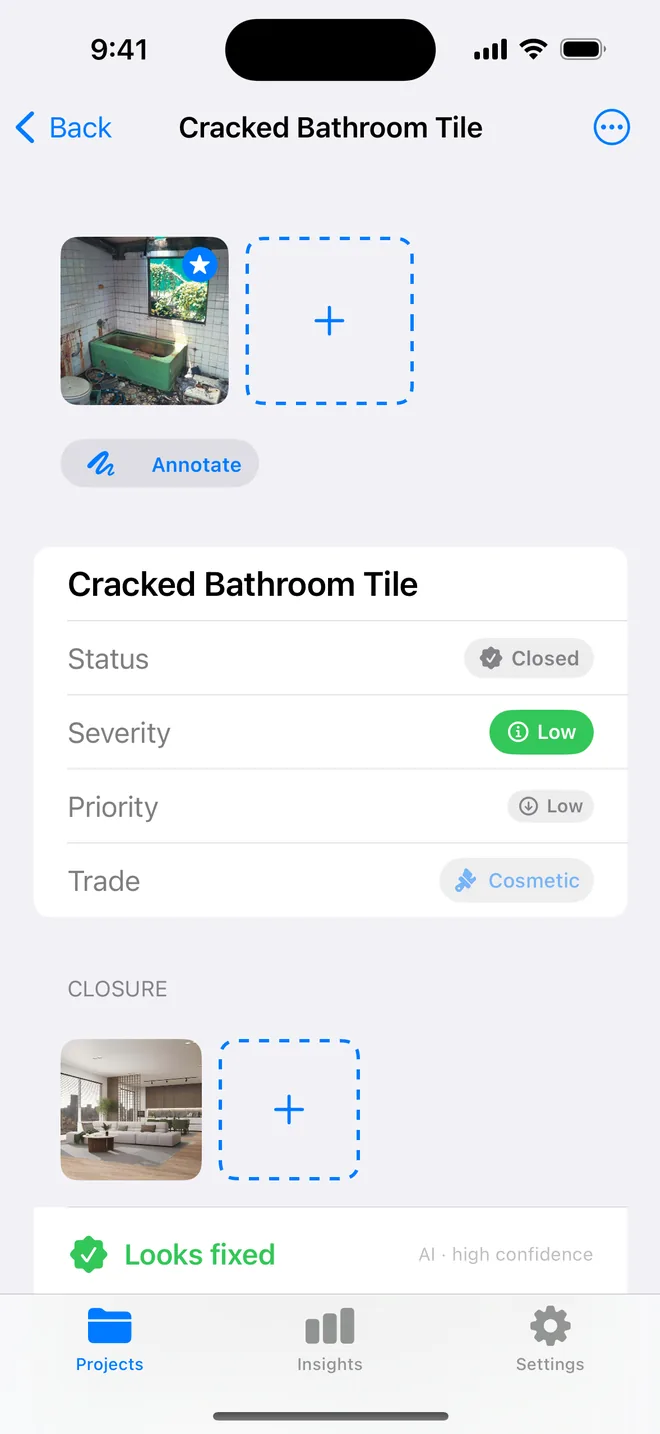

Most defect reports fail that test, and they fail in consistent, fixable ways.
Who you are writing for
Every defect report has at least three readers with incompatible needs, and a good report serves all three without three documents:
| Reader | Wants | Reads |
|---|---|---|
| The client / owner | Reassurance that this was thorough, and a sense of exposure | Cover page, summary, severity counts |
| The contractor / PM | Scope, volume, who is responsible, what it will cost them | Summary, grouping by trade, due dates |
| The subcontractor doing the work | Exactly what to fix, where, and to what standard | Their own items only, in detail |
Design for the third reader. The first two can skim. The third has to act, and every ambiguity you leave costs a site visit.
The structure
- Cover page: project, client, inspector, date, reference, scope
- Scope and limitations: what was inspected, what was not, and why
- Summary: counts by severity, counts by trade, headline concerns
- Definitions: what your severity levels mean
- Defect schedule: the items, grouped
- Appendices: photographs at full size, plans, certificates referenced
The two sections most often missing are limitations and definitions, and both protect you. Limitations tell the client that the roof void was inaccessible before they discover it themselves. Definitions stop "high" meaning whatever the reader is worried about.
The cover page
It carries more weight than its content deserves, it is the first impression of whether the document is professional. It needs:
- Project name and full address
- Client name and, if different, who commissioned the inspection
- Inspector name, company, qualification where relevant
- Date of inspection and date of issue (not the same thing, and the difference matters)
- Report reference and revision
- Weather and site conditions if they affected what could be inspected
- A one-line statement of scope
How to describe a defect
A good defect description has four parts, in this order:
- What is wrong: the observable fact
- Where exactly: location precise enough to walk to without asking
- Extent: how much, how long, how many
- Consequence or required action, why it matters, or what fixed looks like
Compare:
| Poor | Better |
|---|---|
| Grouting bad in bathroom | Grout to floor tiling is cracked and missing along the junction with the bath panel, over approximately 900 mm. Water ingress risk to the substrate. Rake out and re-grout the full run, then apply a mould-resistant silicone bead at the junction. |
| Door doesn't shut | Apartment 4C entrance door binds on the frame at the top hinge side and does not latch without force. Fire door: self-closing performance is compromised. Adjust hinges and closer so the door latches under closer action alone. |
| Paint poor throughout | Level 2 corridor, both walls: patchy coverage with roller lap marks visible under raking light across approximately 12 m. Does not meet the specified finish. Apply a further full coat. |
Language that causes disputes
Some habits reliably generate arguments:
- "Poor", "bad", "unacceptable", "shoddy", subjective, and invite the response "says who?" Describe the observable condition instead and let it speak.
- "Throughout", "various", "generally": unquantified, so unclosable. How many? Which rooms? An item that cannot be verified as fixed will never be closed.
- Naming individuals. "The plasterer has made a mess of", write about the work, never the person. This is both more professional and considerably safer.
- Prescribing method where you should specify outcome. Telling a contractor exactly how to fix something can transfer design responsibility to you. Specify the required end state instead.
- Speculating about cause. "Consistent with" is defensible. "Caused by" usually is not, unless you have investigated.
- Absolutes. "All", "every", "none": one counterexample discredits the item and, by association, the report.
Write for the reader who disagrees with you. Every sentence in a defect report should survive being read by someone who does not want to fix it. Factual, specific, measured: those are not stylistic preferences, they are what makes an item stick.
Photographs as evidence
A defect report without photographs is an opinion. With them, it is a record. What makes a photograph useful:
- Fill the frame with the defect, but include enough context to locate it. Where the defect is small, take two photos: a wide shot showing where, and a close-up showing what.
- Get light on it. Raking light with a torch reveals finish defects that ambient light hides.
- Include scale where extent matters, a tape, a coin, a hand.
- Mark it up. A circle or arrow on the image removes all doubt about what you mean. Annotate on a layer so the original stays intact.
- One defect per photograph where possible. A photo showing five problems will get one fixed.
- Keep the metadata. Date and time on the image are what make it evidence rather than illustration.
Ordering and grouping
There are three sensible orders and they serve different readers:
- By location: best for the walk-through and for re-inspection. The natural default.
- By trade: best for issuing. Each sub gets only their pages.
- By severity: best for the client summary and for triage.
The professional answer is to produce the schedule by location and provide the other two as summary tables at the front. That gives every reader their view without three documents to keep in sync.
The three-pass edit
Before issuing, read the report three times, each with one question:
- Can a sub act on every item without calling me? Any item that fails goes back for location and extent.
- Would every sentence survive being read out in a dispute? Remove judgement words, speculation and absolutes.
- Is the severity honest? Inflated severity is the fastest way to have your whole list discounted. If everything is critical, nothing is.
A worked example
A single item, complete:
RIV-L3-112 · Level 3, Apartment 3B, ensuite shower
Trade: Wet trades · Severity: High ·
Priority: High · Due: 17 Sep 2026
Observation: The silicone seal at the junction between the shower tray and the tiled wall is discontinuous over approximately 120 mm on the left-hand return, with a visible gap at the corner. The bead is also unfinished at the tray edge where it has been applied over dust.
Consequence: Water ingress to the substrate and adjacent construction is likely in normal use.
Required action: Strip the existing bead in full along both returns, clean and dry the substrate, and apply a continuous, tooled mould-resistant sanitary sealant to the specified product.
Photographs: 2 (wide, close-up annotated)
That item costs no phone call. That is the entire standard.
Reports that look like the example, without the evening at a laptop
Punch List AI drafts the observation, consequence and required action from your photograph, keeps the severity definitions in the document, and exports the whole schedule as a branded PDF in one tap.
Get the free appQuestions people ask
What should a defect report include?
For each defect: a reference, the location, a photo, what is wrong in plain words, how serious it is, what should be done and by when. For the report as a whole: who inspected, when, for whom, and under what scope. The field list is here.
How many photos should a defect report have?
At least one per defect, usually two: a wide shot that shows where it is and a close-up that shows what it is. More than three per item is rarely useful, and a report that is all photographs and no words does not get acted on.
How do I write a defect description that will not be disputed?
Describe what you can see, not what you assume caused it, unless you are qualified to say so. "Diagonal crack, 1 mm, from the top corner of the door frame" is hard to argue with; "structural movement" starts an argument.