
Part of the guide: The Complete Guide to Inspection Reports: Structure, Evidence, Sign-off and Examples
If you have worked across the Atlantic, or on a project with a British consultant and an American owner, you have hit this: one side says punch list, the other says snag list, and everyone spends the first five minutes of the meeting establishing that they mean the same thing.

The direct answer
They are the same document. A punch list and a snag list both record defective, incomplete or non-conforming work identified near the end of a construction project, which must be corrected before the work is accepted.
- Punch list: United States, Canada. From the historic practice of punching a hole in the paper beside each completed item.
- Snag list / snagging list: United Kingdom, Ireland, Australia, New Zealand, South Africa, and much of the Gulf where British contract forms are used. From "snag", meaning a small obstacle or catch.
There is no technical distinction. A snag is a punch list item. Snagging is the act of punching.
Regional map
| Region | The list | The activity | The person |
|---|---|---|---|
| US / Canada | Punch list | Punching out, punch walk | Punch list inspector |
| UK / Ireland | Snag list, snagging list | Snagging | Snagging inspector, clerk of works |
| Australia / NZ | Defects list, snag list | Defect inspection | Building inspector |
| South Africa | Snag list | Snagging | Snag inspector |
| UAE / Qatar / Saudi | Snag list (British forms), punch list (US forms) | Both in use | Varies by contract |
| India | Snag list, punch list | Both in use | Site engineer |
In the Gulf in particular, which term you hear depends entirely on whose contract form the project runs on, and it is common to find both in the same document set.
Terms that actually differ
This is the part worth memorising, because these are not synonyms, they are different contractual moments, and getting them wrong in correspondence has consequences.
| US term | UK / Commonwealth equivalent | What it means |
|---|---|---|
| Substantial completion | Practical completion (PC) | The work is usable for its intended purpose; the punch/snag period begins |
| Final completion | Making good of defects / final certificate | All items closed, final payment due |
| Retainage | Retention | The percentage withheld pending completion |
| Warranty period | Defects liability period (DLP) / rectification period | Post-handover window for latent defects |
| Change order | Variation | A change to the contracted scope, not a snag |
| Owner's representative | Employer's agent / contract administrator | Who acts for the client |
| Architect's supplemental instruction | Architect's instruction (AI) | Formal direction to the contractor |
| RFI | RFI / technical query (TQ) | Request for information |
The one that costs money. Confusing a variation (UK) or change order (US) with a snag is the most expensive vocabulary error on this page. A snag is work the contractor already agreed to do and did not do correctly, it is not paid extra. A variation is a change to the scope and it is. Owners who put variations on the snag list, and contractors who accept them without protest, both lose.
Where the processes diverge
The list is the same. The procedural furniture around it differs a little:
- UK residential snagging is a consumer service. Independent snagging inspectors are routinely hired by buyers of new-build homes to inspect before completion, a market with no direct US equivalent at that scale. This is why "snagging list" also appears in a homebuyer context, not just a commercial one.
- US punch lists lean more heavily on formal AIA-style documentation and the certificate of substantial completion as a defined instrument.
- Australian defect lists frequently sit alongside statutory defect-liability regimes that vary by state, so the terminology is more often "defects" than "snags" in formal documents.
None of this changes what belongs on a single item. The field structure is the same everywhere: reference, location, trade, description, photo, severity, action, due date, status.
Writing for a mixed international team
Three rules that avoid almost all confusion:
- Define the term once, at the top of the document. "Defect list (also referred to as punch list / snag list)" in the header of the report costs you nothing and ends the discussion.
- Use neutral wording in item descriptions. "Defect", "issue" and "item" read naturally to everyone. Save the regional term for the document title.
- Match the contract, not your habit. If the contract says practical completion, write practical completion: even if you have said substantial completion your whole career. Correspondence that does not match the contract's own vocabulary is where disputes find room to breathe.
Which term should you use in your own reports?
Whichever your client uses. If you are a UK snagging inspector reporting to a British housebuilder, "snag list" is correct and "punch list" will read as an affectation. If you work for a US GC, the reverse. If your clients span both, title the document "Defect Report" and note the equivalent terms underneath, that is what the larger international consultancies do.
One app, either vocabulary
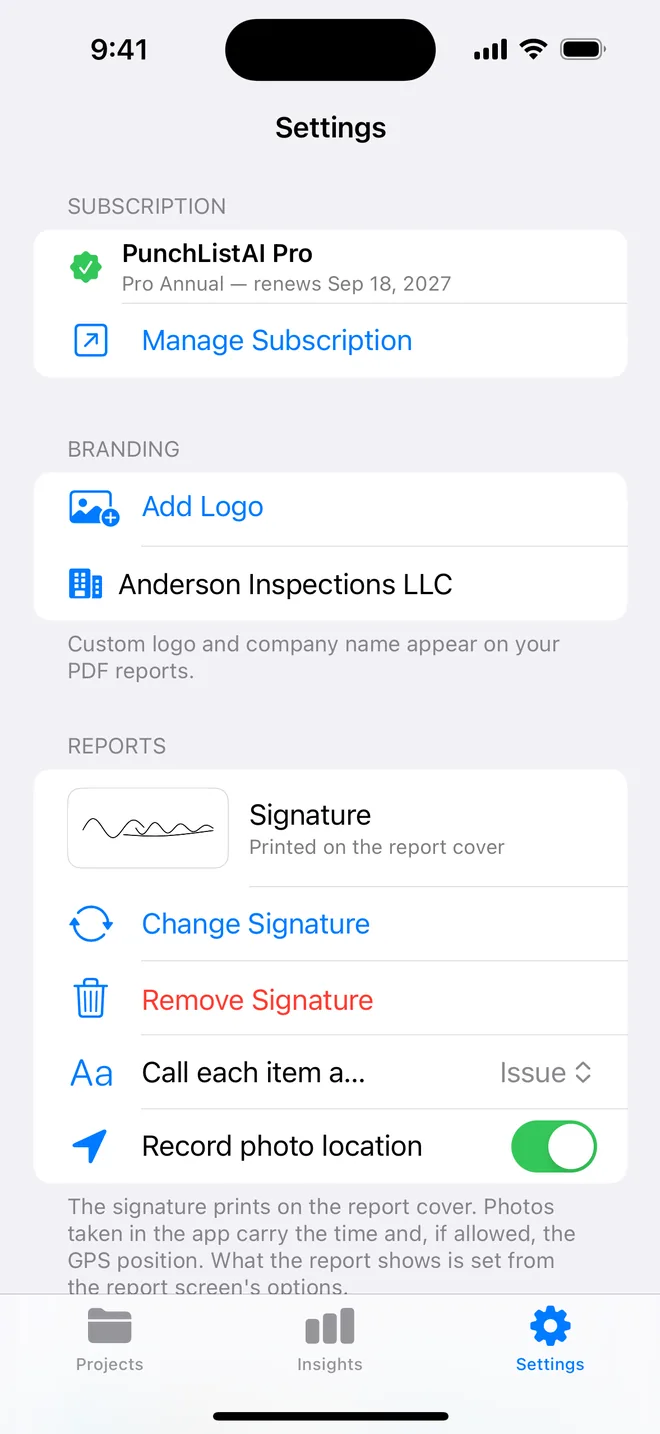
Punch List AI uses neutral wording throughout, "issue", "defect", "severity", so the same report reads naturally whether it lands with a superintendent in Dallas or a housebuilder in Manchester.
Get the free appQuestions people ask
Is a snag list a legal document?
Not on its own, but it is usually referenced by the contract, and it becomes the evidence if there is a dispute at handover or during the defects period. Date it, photograph everything, and keep the version you sent.
What is a deficiency list?
The Canadian term for the same thing. You will also meet defect list, defects schedule and completion list. If you work across borders, pick one term for your reports and put the alternatives in a footnote once.
Who pays to fix snags on a new build?
The builder, within the defects liability period, which is typically 6 to 24 months depending on the country and contract. Anything you do not report inside that window becomes your cost, which is why a thorough pre-handover inspection pays for itself.