
Part of the guide: The Complete Guide to Inspection Reports: Structure, Evidence, Sign-off and Examples
Ask ten people on a job site what a punch list is and you will get ten slightly different answers, most of them right. It is one of those terms everyone in construction uses daily and almost nobody has been formally taught. This guide sets out the definition, the process around it, and the specific failure modes that turn a routine punch list into a three-month argument.
The short definition
A punch list is the itemised record of work that is defective, incomplete or not in accordance with the contract documents, compiled near the end of a construction project, which the contractor must correct before the work is accepted and final payment is released.
The name comes from the old practice of punching a physical hole in the paper next to each item as it was signed off. In the UK, Ireland, Australia, New Zealand, South Africa and much of the Gulf, the same document is called a snag list, and the process is called snagging. The vocabulary differs; the job is identical.
The commercial point. A punch list is not a quality wish list. It is a contractual instrument tied to substantial completion, retention release and, on most contracts, the start of the defects liability period. Items on it have money attached to them.
Where the punch list sits in the schedule
The punch walk is triggered when the contractor declares the work substantially complete, that is, usable for its intended purpose, even if minor items remain. The owner, architect or their representative then walks the building and records everything that falls short.
That is the formal moment, but experienced teams do not wait for it. Running rolling punch lists trade by trade as each area is finished is now standard practice on well-managed projects, for one blunt reason: a defect found before the drywall goes up costs a fraction of the same defect found at handover. The final punch walk should be confirming a short list, not discovering a long one.
Typical sequence
- Pre-punch (contractor's own): the GC and each sub walk their own work and fix the obvious before anyone from the owner's side sees it. Skipping this is the single most common cause of an embarrassing punch list.
- Formal punch walk: owner's representative, architect, GC and often the key subs walk together and record items.
- Distribution: the list is issued, broken down by responsible trade.
- Correction period: subs return and fix. Usually two to four weeks, defined in the contract.
- Back-check: each item is re-inspected and either closed or rejected.
- Final completion: the list is closed, retention is released, warranty period starts.
Who writes it
It depends on the contract and the project size, but in practice:
| Role | What they typically punch |
|---|---|
| Architect / design team | Conformance to design intent, finishes, aesthetics, specified products |
| Owner's representative | Operational readiness, anything the end user will complain about |
| GC superintendent | Everything, pre-emptively, before the formal walk |
| Commissioning agent | MEP systems performance, controls, labelling, O&M documentation |
| Independent inspector / clerk of works | The full scope, on behalf of the owner or a buyer |
| Specialty subcontractor | Their own scope, before calling for inspection |
What a single punch list item must contain
This is where most punch lists quietly fail. An item that reads "Paint touch-up, Room 204" will produce a phone call, a site visit and an argument. An item is only useful if a subcontractor who was not on the walk can act on it without asking a single question.
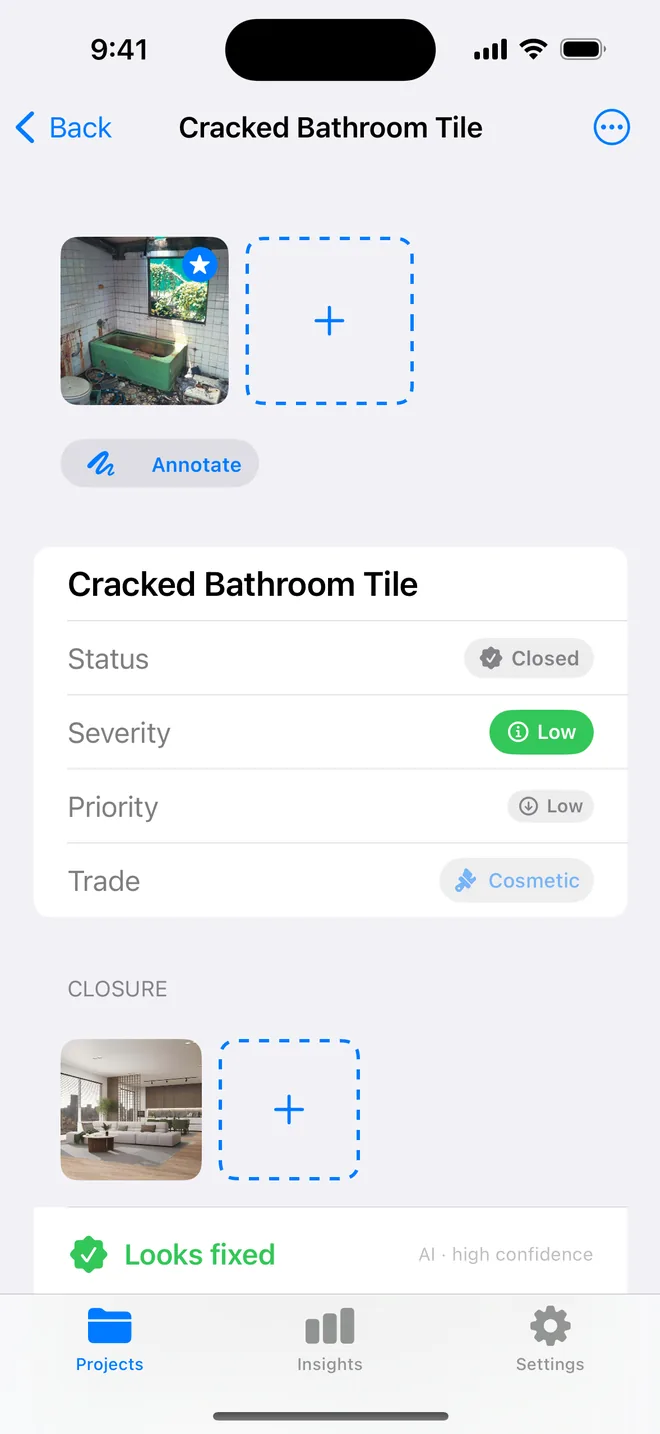
The non-negotiable fields:
- Unique reference: so it can be tracked, disputed and closed unambiguously
- Location: building, level, room number or grid reference. Not "the corridor".
- Trade / responsible party, who fixes it
- Description of the defect, what is wrong, factually, not what you want done
- Photograph: one clear image, ideally with the defect marked
- Severity or priority: so the sub knows what to do first
- Required action: what "fixed" looks like
- Due date
- Status: open, in progress, ready for inspection, closed, rejected
A full field-by-field breakdown, with a template you can copy, is in our punch list template guide.
Weak item vs. strong item
| Weak | Strong |
|---|---|
| Crack in wall, Level 2 | L2-047 · Level 2, Room 214, north wall above door head · Diagonal crack in plaster approx. 300 mm long running from the door frame corner. Consistent with movement or settlement rather than shrinkage. · Photo attached · Severity: medium · Action: expose, assess for structural cause, make good and redecorate to match · Trade: plastering · Due 24 Sep |
| Snagging in ensuite | L3-112 · Level 3, Apt 3B ensuite, shower tray junction · Silicone seal discontinuous over approx. 120 mm at the tray/wall junction; water ingress risk. · Photo attached · Severity: high · Action: strip and reapply full mould-resistant sealant bead · Trade: wet trades · Due 21 Sep |
Write items like the right-hand column without typing them
Punch List AI reads the photograph and drafts the location-aware description, severity and required action for you. You correct rather than compose.
Get the free appThe four stages of closeout
Every item on a properly managed punch list passes through the same four states, and confusion between them is what makes lists drag on:

- Open: recorded, issued, not yet touched.
- In progress / ready for inspection, the sub says it is done. Crucially, this is not closed. The sub does not get to close their own items.
- Closed: re-inspected by whoever raised it and verified.
- Rejected: inspected and still not right. Goes back to open with a note explaining why, because "rejected" without a reason generates another round trip.
A list where subs can mark their own work closed is not a punch list, it is a suggestion box.
Why punch lists fail
In rough order of how often they cause trouble:
- The list is written on site and typed up later. Notes taken on paper or in a camera roll get transcribed that evening, or that weekend, or never. Detail evaporates within hours.
- Items are ambiguous. No location, no photo, no definition of done, so every item costs a phone call.
- No single source of truth. The architect's list, the owner's list and the GC's list are three different spreadsheets. Nobody knows the real number of open items.
- No back-check discipline. Items are closed on the sub's word, then reopened by the owner at final walkthrough, and trust collapses.
- The list is discovered too late. Nothing was punched until substantial completion, so 400 items arrive at once, three weeks before handover.
- Scope creep. Owners add items that are change orders, not defects, and the contractor stops taking the list seriously.
How long should it take?
There is no universal figure, and anyone who quotes one is guessing. What is reasonably consistent across well-run projects is the shape of it: the correction period is defined in the contract (commonly two to four weeks), the list should be shrinking measurably every week, and any item still open after the second back-check is a management problem rather than a construction problem.
The number worth tracking is not "items remaining" but items remaining per trade, with a trend. One sub with 60 open items and no movement is a completely different situation from ten subs with six each.
Punch list vs. warranty work
They are frequently confused, and the distinction matters commercially.
| Punch list item | Warranty / defects liability item | |
|---|---|---|
| When identified | At or before substantial completion | After handover, during the defects liability period |
| Nature | Work never completed correctly | Work that was accepted but has since failed |
| Tied to | Retention release, final payment | The warranty obligation |
| Typical example | Missing sealant at handover | Sealant that cracked after eight months |
Recording both in the same system, with a field distinguishing them, saves a great deal of argument later , particularly when the same defect reappears and you need to prove whether it was ever properly closed the first time.
The practical takeaway
A punch list is only as good as the individual item. Everything else: the software, the meetings, the dashboards: is scaffolding around whether a subcontractor can read one line and know exactly what to fix, where, and to what standard.
Get the item right and the rest of the process becomes administrative. Get it wrong and no amount of tooling will save the closeout.
Questions people ask
Who is responsible for the punch list?
The contractor fixes the items, but the owner's side writes the list: the architect, the owner's representative or an independent inspector. If the contractor writes their own punch list, expect it to be short.
How long does a punch list take to close?
Two to four weeks is normal for a house; larger commercial projects run longer because trades have to come back in sequence. The list itself should take a day to write, not a week. Most delays come from vague items, which is why how you describe each one matters more than how many there are.
Is a punch list the same as a snag list?
Yes. Punch list is the North American term, snag list the British, Irish and Australian one. The regional vocabulary is here; the document and the process are the same.
What happens if the contractor does not complete the punch list?
Retention is the lever: most contracts hold back a percentage of the final payment until the list is signed off. Keep the list dated, photographed and specific, because it becomes the record if the money is ever disputed.