
Part of the guide: The Construction Defect Field Guide: 40 Defects by Trade, With Photos
After enough handover inspections you stop being surprised. The same fourteen or so defects account for the large majority of items on almost every list, across building types and countries, because they share the same root causes: work done last, work done by the trade that follows another trade's damage, and work nobody looks at because it is at knee height.
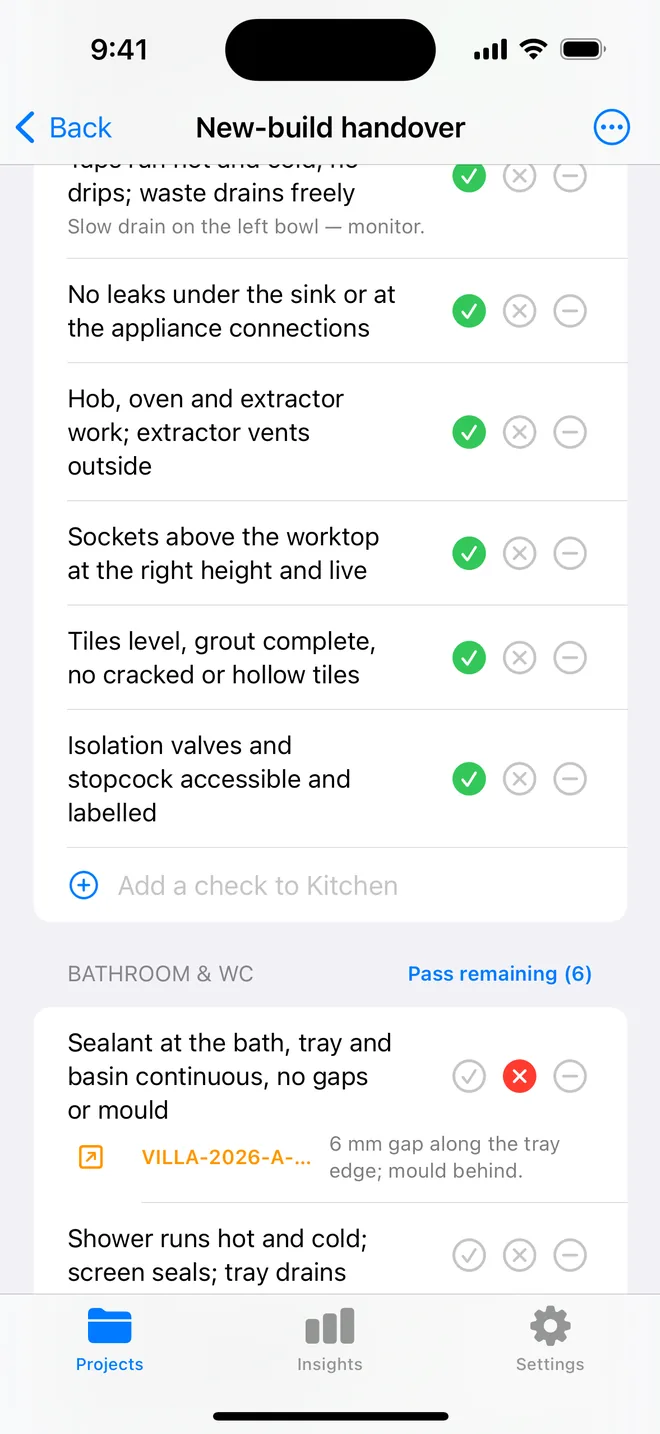

Knowing the list in advance does two things. It makes you faster, and, more importantly, it stops you missing the dull ones while you concentrate on something interesting.
Why the same defects recur
- Sequence damage. A finished surface gets damaged by a later trade. Nobody owns it, so nobody fixes it until someone punches it.
- Last-day work. Sealant, touch-up paint, ironmongery adjustment, all done under time pressure at the end, by whoever is left.
- Nobody's scope. The gap between two subcontractors' scopes is where defects live.
- Invisible under site lighting. Temporary lighting flatters finishes. Daylight and raking light do not.
The 14
1. Discontinuous or poorly tooled sealant
The single most common item on any list. Baths, shower trays, worktops, window perimeters, sanitaryware, skirting junctions. Look for gaps, bubbles, beads applied over dust, and silicone applied in two sessions with a visible joint.
Record: location, which junction, length of the affected run, and whether it is a water-risk position.
2. Paint coverage and finish defects
Roller lap marks, patchy coverage over filler, missed edges behind radiators and pipes, overspray on ironmongery, brush marks on gloss. Invisible under ambient light, obvious under raking light.
Record: the wall or area, approximate extent in metres, and the specific defect, not "paint poor".
3. Doors that bind, drop or fail to latch
Open, close and latch every single door. Doors that were fine when hung move as the building dries. Fire doors that do not latch under closer action alone are a compliance failure, not a snag.
Record: door reference, which edge binds, and whether it is a fire door.
4. Damaged or misaligned ironmongery
Handles loose, mismatched with the schedule, fitted at inconsistent heights, scratched during installation. Latches and hinges that need force.
5. Tiling: lippage, cut sizes and missing movement joints
Lippage between adjacent tiles you can feel with a fingertip, sliver cuts at edges where the setting-out was started from the wrong end, grout cracking at internal angles where a flexible sealant should have been used, missing movement joints in large floor areas.
6. Grout cracking at internal angles
Worth separating from tiling generally because the cause is specific and recurrent: rigid grout used where a flexible sealant belongs. It will crack again after the fix unless the correct material is specified.
Record: and state the required material, or you will punch the same item twice.
7. Skirtings and architraves: gaps, mitres and scribing
Open mitres at external corners, gaps to the floor where the screed is uneven, architraves not scribed to frames, visible fixings not filled.
8. Plaster cracking at openings
Fine cracks radiating from door and window frame corners. Usually shrinkage and cosmetic, occasionally movement. Record direction and length; do not diagnose cause unless you have investigated.
9. Missing or incomplete fire-stopping
The most serious item that regularly appears. Service penetrations through compartment walls and floors left unsealed, sealed with the wrong material, or partially sealed. Look above ceilings, in risers and in cupboards.
Record: photograph every penetration. This is the item most likely to matter years later, and the one most likely to be covered up before it is fixed.
10. Electrical accessories not square, not secure, wrong type
Sockets and switches rotated a few degrees, proud of the wall, loose in the box, or standard fittings used in wet or external locations. Also: unlabelled distribution boards, and covers left off.
11. Trap, leak and drainage defects found only by running water
You will not find these by looking. Run every tap, fill and drain every basin, bath and shower, and flush every WC twice. Check under the unit while it drains. Traps missing, cross-threaded, dry, or discharging into a disconnected pipe.
12. Blocked or ponding external drainage and rainwater goods
Gullies full of construction debris, downpipes discharging onto the ground rather than into a gully, gutters with reversed falls, ponding on flat roofs, outlets blocked with membrane offcuts.
13. Ceiling access panels painted shut, missing, or misaligned
Small, dull, and consistently forgotten, until maintenance needs one. Check every panel opens.
14. Handover documentation incomplete
Not a physical defect, and the one that delays handover most often. Missing test certificates, O&M manuals without the equipment actually installed, warranties not registered in the client's name, keys unlogged, as-builts that do not match reality.
Honourable mentions that just miss the list: scratched glazing, damaged window restrictors, kitchen drawer alignment, silicone colour mismatch, loose bath panels, condensate pipes terminating badly, and door bottoms left unpainted.
The techniques that find most of them
- Raking light. Hold a torch flat against the surface and sight along it. Finds nearly every finish defect on the list, and takes seconds per wall.
- Run the water. Not a glance: thirty seconds of flow per outlet, then look underneath while it drains.
- Operate everything. Every door, window, drawer, panel, restrictor, lock. If it moves, move it.
- Look up. Lift ceiling tiles, open access panels, check above the line of sight.
- Get to knee height. Skirtings, door bottoms, trap boxing, the underside of worktops. Most inspections happen entirely between waist and eye level.
- Come back in daylight if you inspected under temporary lighting.
How to record them so they get fixed once
These defects are common enough that the descriptions become formulaic, which is an advantage, provided the formula includes the details that make each instance actionable:
- Exact location, not the room type. "Apt 3B ensuite, shower tray left return" not "bathroom".
- Extent in real units. "Approximately 120 mm", not "some".
- The required material or standard where the fix has a specific answer, as with grout versus flexible sealant at internal angles. Otherwise it comes back.
- A photograph with the defect marked. On the recurring, low-severity items especially, an annotated image saves more time than the description does.
The full field structure is in our punch list template guide, and the walking order that catches these in sequence is in the site inspection checklist.
Fourteen recurring defects, fourteen write-ups you should not be typing
Photograph it and Punch List AI produces the description, extent, severity and recommended fix, then exports the whole list as a report before you leave the building.
Get the free appQuestions people ask
What is the most common snag on a new build?
Finishing defects: paint, sealant and caulking, followed by doors that catch and windows that do not lock cleanly. They are cheap to fix and easy to miss because your eye stops seeing them after the third room.
When should a snagging inspection be done?
Before you complete, ideally a week before, so the builder has time to fix items while the trades are still on site. If you have already moved in, do it within the first weeks; anything found later is harder to attribute.
Can I do my own snagging inspection?
You can, with a torch, a level and a checklist you follow room by room. A professional finds more in less time and writes a report the builder takes seriously, which is worth it on a new build where the defects period is the only free repair window you will get.