

Part of the guide: The Complete Guide to Inspection Reports: Structure, Evidence, Sign-off and Examples
Practical completion and substantial completion are the same milestone under different names: the point at which the building can be used for its intended purpose, even though minor items are still outstanding. Practical completion is the term in the UK, Australia and New Zealand; substantial completion is used in the United States, and substantial performance in Canada. Final completion comes later, when the outstanding items and the defects found afterwards have been put right and the last payment, including retention, is released.
The punch list sits between the two. It is attached to the handover certificate and closed before final completion, which is why the vocabulary matters to anyone who writes one.

What each term means under the main contracts
United States (AIA). Substantial completion is the stage when the work is sufficiently complete for the owner to occupy or use it for its intended purpose. The architect issues a certificate of substantial completion with the list of items to be completed or corrected attached. The contractor's obligation to correct work that proves defective runs for one year from substantial completion under A201, and final completion follows when the list is closed and final payment is made.
Canada. Substantial performance has a statutory meaning in the provincial lien legislation, often tied to a cost test, and it starts the clock on the holdback period. The 2008 edition of CCDC 2 uses substantial performance and the later total performance of the work, with a warranty period after it; the 2020 edition adds ready-for-takeover as the handover milestone.
United Kingdom (JCT). The contract administrator certifies practical completion. The rectification period then runs, six months unless the contract states otherwise, and at its end the contract administrator issues a schedule of defects. When those are made good, a certificate of making good follows, and the final certificate after that.
United Kingdom (NEC4). Completion is defined in the scope. The contractor corrects notified defects up to the defects date, and the supervisor then issues the defects certificate.
Australia (AS 4000). The superintendent certifies practical completion, the defects liability period follows, often twelve months, and the final certificate closes the contract.
New Zealand (NZS 3910). Practical completion, then the defects notification period, then final completion.
What changes on the day of handover
The handover certificate is not only a formality. Depending on the contract, it usually:
- moves responsibility for insuring and securing the building to the owner;
- stops liquidated damages for delay from running;
- releases part of the retention or holdback, commonly half in UK practice;
- starts the defects period and the clock on any latent defects claims.
That is why contractors push for it and owners are careful about it. A certificate issued with a long list of significant items attached gives away bargaining power the owner will not get back.
Where the punch list fits
The punch list is written at or just before handover, attached to the certificate, and closed during the defects period. Two kinds of item end up on it:
- Incomplete or defective work known at handover. These are the items on the list attached to the certificate.
- Defects that appear afterwards. The owner notifies them during the defects period; the contractor returns to fix them. They join the same numbered list, so the history of the building stays in one place.
A useful test for whether the building is ready for handover: could the owner move in and use it tomorrow, with the remaining items fixed around them without disruption? If not, it is not practically complete, however short the list looks.
Common mistakes
- Mixing the vocabularies. Writing "substantial completion" in a JCT contract, or "practical completion" to a US owner, invites the question of which contractual event you mean.
- Handing over with safety items open. Fire stopping, guarding, emergency lighting and certification are not minor items, whatever the list calls them.
- No record of the condition at handover. Without dated photographs, every later defect becomes an argument about whether it was there on day one.
- Letting the defects period lapse. Defects notified after the period ends may still be claimable, but through a much slower route.
What to do next
Check which contract form you are working under and use its terms in your list and your correspondence. At handover, attach a numbered list with photographs, record the condition of the building, diarise the end of the defects period, and walk it again a few weeks before it ends.
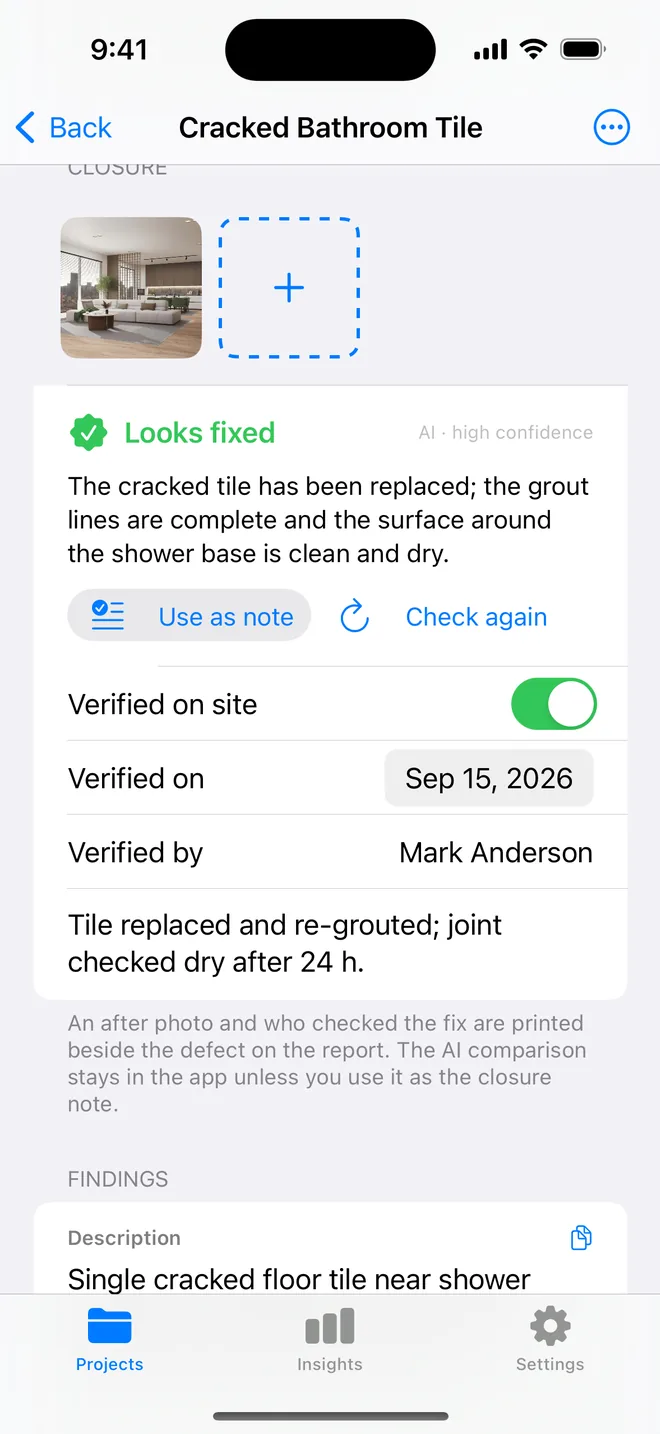
Punch List AI keeps the handover list and the defects notified afterwards in one project, with the dates on every photo, and prints before and after side by side when each item is closed.
Keep the handover list on your phone
Free to download. One numbered list from handover to final completion.
Download on theApp StoreQuestions people ask
Is practical completion the same as substantial completion?
In practice, yes: both mark the point at which the building can be used for its purpose with minor items outstanding. The exact definition and consequences come from the contract, so check the form you are using.
Can practical completion be certified with defects outstanding?
Yes, if they are minor and do not prevent use. They are listed and fixed during the defects period. Significant defects normally prevent certification.
When is retention released?
Commonly half at practical completion and the rest at the end of the defects period, in UK practice. US retainage and Canadian holdback follow the contract and, in Canada, the provincial lien legislation.