

Part of the guide: The Complete Guide to Inspection Reports: Structure, Evidence, Sign-off and Examples
On most commercial projects the general contractor is responsible for the punch list. The contractor compiles it when it believes the work is substantially complete, its subcontractors fix the items in their scope, and the architect or contract administrator adds anything the contractor missed, checks the fixes and certifies completion. The owner accepts the building and releases the money held back. On a new home sold to a private buyer, the buyer or their inspector often writes a separate snag list, and the developer is responsible for putting it right.
That is the short version. The detail depends on the contract, and the disagreements on site almost always come from people assuming a different split from the one they signed.
What the main contract forms say
United States (AIA A201). When the contractor considers the work substantially complete, it prepares and submits to the architect a comprehensive list of items still to be completed or corrected (section 9.8.2 of the 2017 edition). The architect then inspects. If the architect finds items the contractor did not list, they are added, and the work is not certified until it is substantially complete. The certificate of substantial completion goes out with the list attached, and the contractor finishes the items before final payment.
Canada (CCDC 2). Broadly the same pattern: the contractor typically lists the deficiencies when it asks the consultant to review the work for handover, the consultant reviews and confirms the list, and the holdback rules in the provincial lien legislation decide when the money moves.
United Kingdom (JCT and NEC). Practice differs more. Under JCT contracts the contract administrator certifies practical completion, often with a list of minor items attached, and at the end of the rectification period issues a schedule of defects that the contractor must make good. Under NEC4 the supervisor notifies defects and the contractor corrects them within the defect correction period. In both, the contractor remains responsible for the work; the consultant's job is to identify, not to fix.
Australia (AS 4000 and similar). The superintendent decides when practical completion is reached and the contractor makes good defects notified during the defects liability period.
None of these forms makes the architect or the owner responsible for finding every defect. Their list is a check on the contractor's, not a replacement for it.

Who does what, step by step
A typical sequence on a commercial fit-out or a multi-storey residential job looks like this.
- The contractor's own walk. The site manager or project engineer walks each area with the subcontractors' foremen before telling anyone the area is ready. This is the list that matters most, because it is the one written while the trades are still on site.
- The subcontractors fix their items. Each item carries an assignee: the drylining contractor, the electrician, the flooring installer. Items with no assignee stay open longest.
- The contractor declares the area ready and invites the architect or contract administrator to inspect.
- The consultant's walk. The architect, often with the owner's representative, walks the same areas and adds what the contractor missed. The combined list is issued, usually with due dates.
- Back-check. The contractor reports items as done; the consultant verifies each one, ideally against a photograph of the original defect, and closes it. Items that are not right go back to open under the same number.
- Certification and payment. Once the list is closed, or reduced to agreed minor items, the consultant certifies and the owner releases the remaining payment and, in time, the retention.
What subcontractors are responsible for
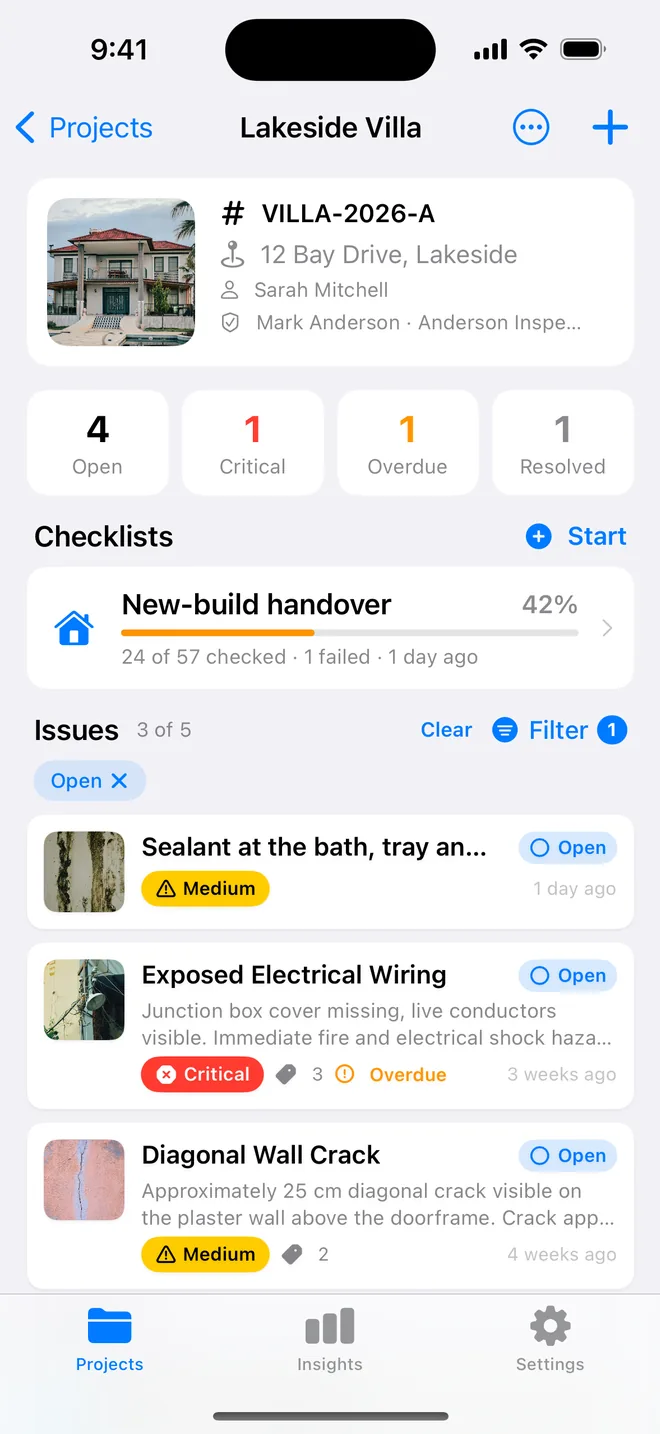
A subcontractor is responsible for its own scope and for damage it causes to other trades' work. It is not normally responsible for items outside its package, even when they are in its area, and it deals with the main contractor, not with the owner or the architect. That is why a clear assignee on every row matters: the subcontractor sees a list of its own items, with locations and photos, and the main contractor keeps the overall view.
Two situations cause most arguments:
- Damage by others. A scuffed wall after the flooring went in, a cracked tile after the kitchen fitter's visit. The item is recorded against the trade that has to repair it, and the main contractor decides separately whether to charge the cost back to the trade that caused it. Keep the two questions apart on the list, or nothing gets fixed while the blame is discussed.
- Items between packages. A gap between a worktop and a tiled splashback belongs to whoever the contract says finishes that junction. If nobody knows, the main contractor owns it until it is resolved.
Owner-supplied items and design issues
Not every item on a punch list is the contractor's to fix. Furniture, equipment and systems supplied directly by the owner are the owner's responsibility, and a defect caused by the design, rather than by the workmanship, is a question for the designer and usually a change to the contract. Put these on the list anyway, marked with the right owner, because leaving them off makes the list look shorter than the work that remains.
Common mistakes
- Waiting for the architect's walk. A contractor who hands over without its own list gets a longer list back, and a second inspection it may have to pay for.
- Vague locations. "Bedroom, paint" on a building with forty bedrooms. Use the room number and the element.
- Prescribing the fix. The consultant describes what is wrong and what standard applies; the contractor decides how to put it right. See how to word items without prescribing the method.
- Closing items on the subcontractor's word. "Done" means ready for inspection, not closed. Close it when someone has checked it and recorded who did.
What to do next
If you are the contractor, walk every area with your trades before you call anyone, and put an assignee and a due date on every item. If you are the consultant or the owner's representative, add to the contractor's list rather than starting a separate one, and verify each item against a photograph. Either way, one numbered list, one owner per item and a record of who closed it is what gets a project to final payment without a dispute.
Punch List AI is built around that list: each item starts from a photo, carries its assignee and due date, and the report shows who verified each fix.
Run the walk on your phone
Free to download. Each item gets a number, a photo, an owner and a due date as you walk.
Download on theApp StoreQuestions people ask
Does the architect have to find every defect?
No. Under the main contract forms the consultant's list is a check on the contractor's work, not a guarantee. The contractor remains responsible for delivering the work to the contract.
Who pays for fixing punch list items?
The contractor, as part of the contract price, and through it the subcontractor whose work is defective. Owner-supplied items and design changes are the exceptions.
Can a subcontractor refuse an item?
It can dispute that the item is in its scope. The main contractor decides, and remains responsible to the owner either way.
Who writes the snag list on a new home?
In the UK the buyer or an inspector they hire usually writes it, and the developer is responsible for fixing it. See who fixes snags on a new build.