

Part of the guide: The Complete Guide to Inspection Reports: Structure, Evidence, Sign-off and Examples
A back charge is a cost a main contractor deducts from a subcontractor's payment because the contractor had to pay for something the subcontractor should have done or caused: correcting its defective work, repairing damage it did to other trades' work, clearing its waste, or covering delay it caused. It is a right given by the subcontract, not by law, so it only holds up if the contractor follows the subcontract's terms, which usually means written notice and a chance for the subcontractor to put things right first. In the UK the same thing is usually called a contra charge.

When a back charge is justified
- Defective work the subcontractor did not correct after notice, so the contractor had another trade do it.
- Damage to other trades' work: an electrician cutting into finished drywall, a flooring installer chipping a door frame.
- Clean-up the subcontractor was responsible for and did not do.
- Delay costs, where the subcontract allows them and the cause can be shown.
The common thread is cause. A back charge needs evidence of who caused the cost, not only that the cost exists.
What makes it hold up
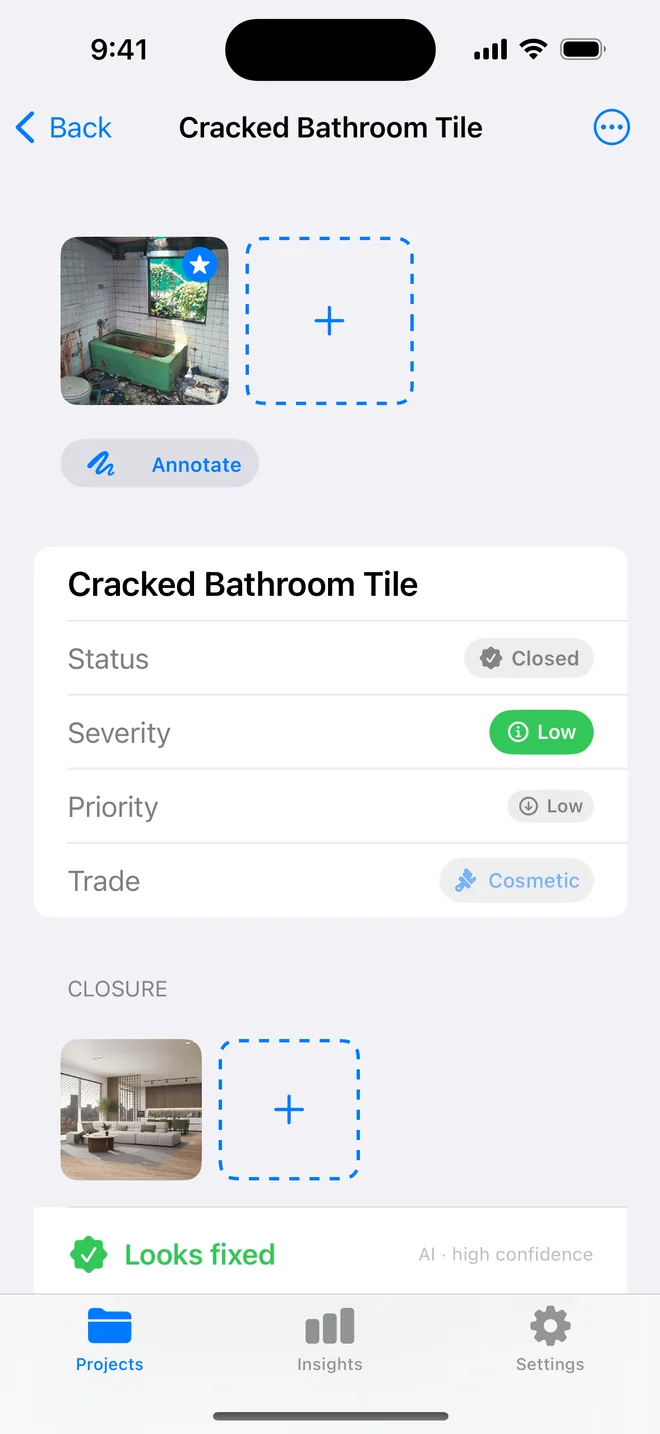
- Record it when it happens. A photograph, the date, the location, and how you know which trade caused it. A punch list item recorded before the damage and another after it is strong evidence.
- Give written notice in the way the subcontract requires. Many subcontracts, including the standard US forms, require notice and an opportunity to correct before the contractor can do the work itself.
- Allow the cure period if there is one. Charging for work the subcontractor was never asked to fix is the most common reason a back charge fails.
- Cost it accurately: the actual cost of the fix by others, with invoices or timesheets, plus any markup the subcontract allows.
- Deduct with the backup attached, on the payment application or certificate, so the subcontractor can see exactly what is charged and why.
The rules outside the US
United Kingdom. Under the Housing Grants, Construction and Regeneration Act 1996, as amended, a payer who wants to pay less than the notified sum must give a valid pay less notice within the contract's time limits. A contra charge deducted without one is vulnerable, whatever its merits, and subcontractors regularly win adjudications on that point.
Australia. Under the security of payment legislation in each state, a respondent that wants to pay less than a payment claim must say so, with reasons, in a payment schedule served on time. Back charges not set out there are hard to rely on later.
Common mistakes
- No notice. The subcontractor hears about the charge when the payment is short.
- No evidence of cause. "Someone damaged it" is not a back charge.
- Charging a premium. Inflated rates turn a fair charge into an argument about the rate.
- Holding it for the final account. Charges raised months later, in a batch, are the hardest to prove. Raise them as they happen.
What to do next
Read the notice, cure and set-off terms in your subcontracts before you need them. Then record damage and defects as they happen, with photographs and the trade responsible, notify in writing, and deduct with the evidence attached. The same record keeps disputes short when the charge is challenged.
Punch List AI gives each item a number, a photo with the capture time, an assignee and a status history, which is the record a back charge relies on.
Record damage as it happens
Free to download. Every item dated, photographed and assigned to a trade.
Download on theApp StoreQuestions people ask
Is a back charge legal?
It is a contractual right, not a statutory one. Whether it stands depends on the subcontract's terms and, in the UK and Australia, on the payment notice rules.
What is a contra charge?
The usual UK term for a back charge: a deduction from a subcontractor's payment for costs the contractor incurred because of the subcontractor.
Can a subcontractor dispute a back charge?
Yes. The usual grounds are no notice, no chance to cure, no evidence of cause, or an inflated cost.