
Part of the guide: How Much Does a Snagging Inspection Cost in the UK? (2026 Prices)
There is a great deal of noise about AI in construction, and most of it describes a product nobody has shipped. This is an attempt at the honest version: what vision models are actually good at when pointed at a defect photograph, where they fall over, and how a working inspector should think about the line between the two.
Disclosure up front: we make an app that does this. That is a reason to read the limitations section carefully, not a reason to skip it, we would rather you understand the boundary than be disappointed by it.
What changed
Two things, both recent. First, vision-capable language models became good enough to describe an image in domain-specific, structured language rather than generic captions, the difference between "a wall with a crack" and "diagonal crack in plaster running from the door frame corner, consistent with movement rather than shrinkage". Second, they became fast and cheap enough to run on a single photo in a couple of seconds for a fraction of a cent, which is what makes per-defect analysis viable rather than a research demo.
Neither of those is intelligence about buildings. Both are competence with language about images. That distinction explains almost everything that follows.
What AI genuinely does well
Turning a photograph into written English
This is the core competence and it is genuinely strong. Given a clear photo of a visible defect, a current model will produce a description that is specific, uses the correct trade vocabulary, and reads like something a competent inspector wrote. It will note the approximate extent, the location within the frame, and the visible characteristics.

Consistent classification
Assigning a category: structural, envelope, MEP, finishes, safety, and a severity level is a task where models are reliable and, importantly, consistent. A human inspector at 4pm on a Friday classifies differently than at 9am on Monday. A model does not drift.
Drafting the remedial action
Standard defects have standard fixes, and the model has read a great deal about them. For discontinuous sealant, cracked grout, missing fire-stopping or damaged trim, the suggested action is usually exactly what you would have written.
Reading patterns across a body of work
This is underrated and possibly the most valuable application. One inspector cannot easily hold in their head that a particular sub has generated 60% of criticals across four projects, or that the same detail keeps failing on the same building type. Aggregating structured issue data and surfacing the pattern is straightforward for a model and genuinely hard for a person.
What it cannot do
This list matters more than the one above.
- See what is not in the photograph. No model knows what is behind the plasterboard, whether the fixings are the specified ones, or what the drawing said. It describes pixels.
- Determine cause. It can say a crack is consistent with movement. It cannot tell you the building is moving. That requires exposure, monitoring and an engineer.
- Judge compliance. Compliance is against a specification and a code, both of which are project-specific documents the model has not read. A model saying a handrail "appears low" is a prompt to get your tape measure, not a finding.
- Assess structural adequacy. Ever. This is the hard boundary. Loads, capacity and safety factors are engineering, not image description.
- Estimate cost reliably. Rates are local, current and contractual. A model's number is a plausible-sounding guess.
- Be accountable. Your name goes on the report. The model's does not.
The one-sentence rule. AI is good at writing up what you already saw. It is not good at seeing things for you. Every failure mode in practice comes from someone reversing that sentence.
The transcription gap is the real problem
Here is the thing the industry conversation keeps missing. The bottleneck in inspection has never been finding defects. Experienced inspectors find them fine. The bottleneck is the gap between seeing a defect and having a written record of it that somebody else can act on.
What actually happens on most sites: the inspector photographs forty things, scribbles abbreviated notes, and writes the report that evening or the next morning. By then a proportion of the photographs no longer have a clear associated memory. "IMG_4471: crack?" Where? Which wall? How long? The item that gets written is vaguer than the one that was seen, and the vagueness is what generates the phone calls and the rejected fixes.
That gap, not defect detection, is where the value is. Closing the item while you are still standing in front of the defect means the record has the specificity your eyes had. AI is useful here because it removes the typing, not because it removes the looking.
How to use it without risking your judgement
- You find the defect. The tool writes it up. Never walk a site expecting software to spot things. Walk it the way you always have.
- Read every generated description before saving it. If you would not have written it, change it. It takes four seconds.
- Treat severity as a suggestion. The model does not know the client, the programme or what is behind the wall. You do.
- Delete confident nonsense immediately. Occasionally a model will describe something with total assurance and be wrong. The fix is that you read it, which is why point 2 is not optional.
- Photograph properly. Fill the frame with the defect, include enough surroundings to locate it, and get the light right. Output quality tracks input quality almost linearly.
- Never let it describe what it cannot see. If the defect is hidden, the photo is useless and so is the write-up.
Liability and professional responsibility
Worth being blunt: using an AI tool changes nothing about who is responsible. The report carries your name and your professional judgement. A generated description you did not read is a description you wrote badly.
Practical consequences:
- Review before saving is not a nicety, it is the whole basis on which the output becomes yours
- Do not put AI-generated severity into a report you have not personally agreed with
- Be aware of what leaves your device. Site photographs can contain confidential information, faces, and identifiable client details. Check what any tool transmits and to whom, and check whether it is used to train models.
- Some clients and public-sector frameworks now require disclosure of AI use in reports. Ask rather than assume.
What is probably next
Predictions are cheap, so here are only the ones that look close to inevitable:
- Drawing awareness. Linking a photo to a location on a plan, so the model can reason about where it is rather than only what it sees. The technology exists; the integration work is the obstacle.
- Cross-project benchmarking. Meaningful comparison of defect rates between trades, contractors and building types: valuable, and commercially delicate.
- Progressive capture. Continuous photographic records through the build rather than a snapshot at completion, with change detection between visits.
What is not close: an app that walks a building and produces a complete, reliable defect list without an inspector. Anyone selling that today is selling a demo.
The narrow, useful version
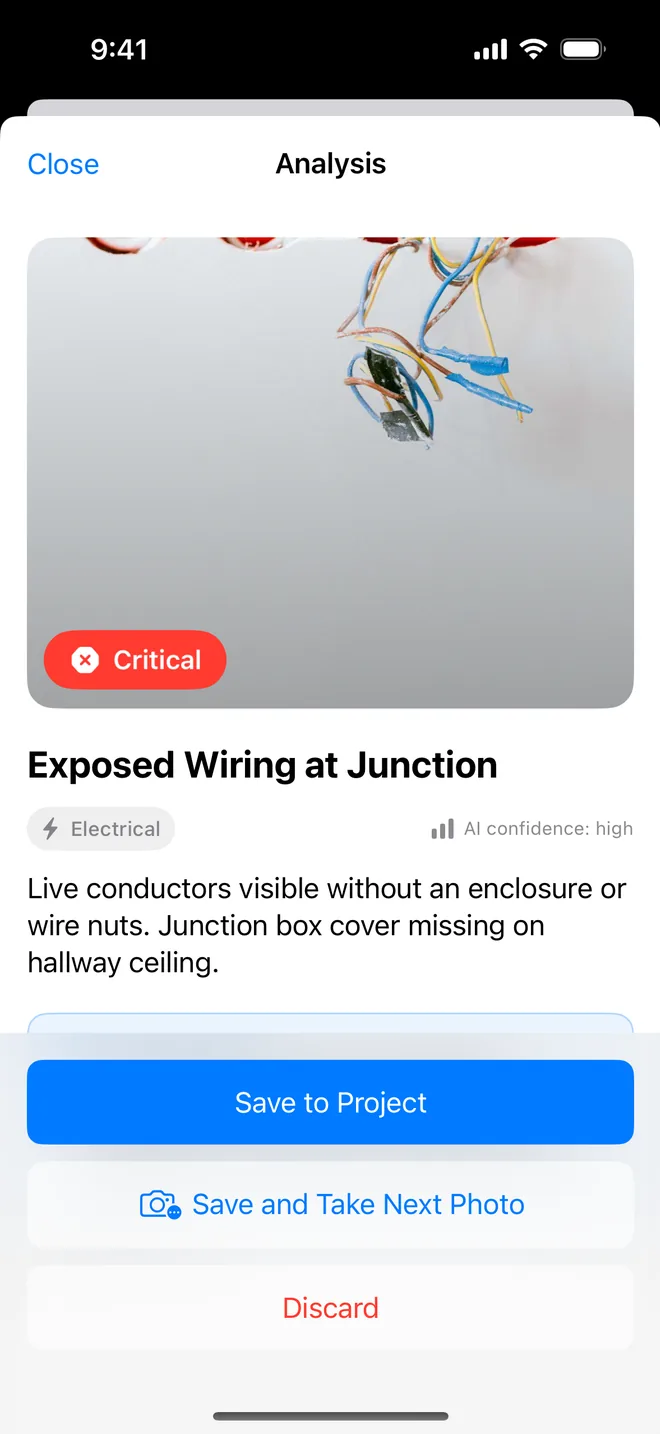
Punch List AI does exactly what this article describes as valuable: you photograph the defect you found, and it writes the item, description, category, severity, recommendation, for you to check and correct. Everything is editable, and your projects stay on your device and in your own iCloud.
Get the free appQuestions people ask
Can AI replace a site inspector?
No, and it should not try. It can draft what a defect looks like and suggest a severity; it cannot walk the route, notice what is missing, or sign the report. Treat it as a fast first draft that you correct.
Is it safe to send site photos to an AI service?
Read the provider's policy before you decide. The one this site's app uses does not train on your photos and processes them through a relay that stores nothing; the details are in the privacy policy. Whatever tool you use, do not photograph documents or people you do not have consent for.
How accurate is AI at identifying construction defects?
Good on clear, common defects in a well-lit photo: cracks, water staining, exposed wiring, damaged finishes. Weaker on cause, on anything hidden, and on severity when context matters. That is why the inspector reviews every draft before it goes on a report.