
The price of a snagging inspection is the easy question and the one most guides stop at. This one goes further: what the fee includes, what quietly moves it, when it is worth paying and when it is not, what the money buys in terms of the inspector's time, and how to tell a £300 inspection from a £300 walk-through. It is written for the buyer paying the fee and for the inspector setting it, because both need the same numbers.
Prices below are for England and Wales in 2026, including VAT unless stated. Scotland and Northern Ireland run slightly lower outside the cities. Everything here was checked against published price lists in September 2026; the sources are at the end.
The short answer: 2026 prices by property size
| Property | Typical 2026 price | Notes |
|---|---|---|
| Studio, 1- or 2-bedroom flat | £249 – £350 | RICS-regulated firms start around £320 |
| 2- or 3-bedroom house | £299 – £450 | The most common booking; national firms cluster at £300–£400 |
| 4- or 5-bedroom house | £349 – £500 | Detached with a garage sits at the top of the range |
| 6+ bedrooms, or unusual property | from £500 | Priced on application; expect a half-day plus |
| Re-inspection (checking the fixes) | £100 – £370 | Cheapest as an add-on booked with the first visit |
| Inspection + re-inspection package | £549 – £950 | Sold as "plus" or "premium" packages by the larger firms |
Two things the table hides. First, the bottom of each range is usually a sole trader outside a major city, and the top is a national firm or a RICS-regulated surveyor in the south-east. Both can be excellent; the price is telling you about overheads and accreditation, not about how many defects will be found. Second, the "from" price on a firm's website is almost always the flat price; houses cost £50–£150 more once you have entered the bedroom count.

What does a snagging inspection include?
A proper inspection is a systematic visual check of everything you can see, open, switch or run, inside and out, without taking anything apart. In practice that means:
- Externally: roof coverings from the ground, gutters and downpipes, brickwork and pointing, render, windows and doors from outside, cills and drips, damp-proof course level against the ground, paving falls and drainage covers, fences, garage and outbuildings.
- Internally, every room: walls and ceilings in raking light for plaster and paint defects, every door and window operated and locked, every socket and switch, every tap run and every waste checked for leaks, showers run and the junctions watched, radiators, extract fans, alarms tested, floors walked for squeaks and gaps, kitchen units and worktops, sanitaryware fixings, sealant everywhere it should be.
- Loft and services: insulation coverage, ducts that actually terminate outside, water tank lids, the consumer unit labelled, meter and stopcock locations, boiler commissioning paperwork.
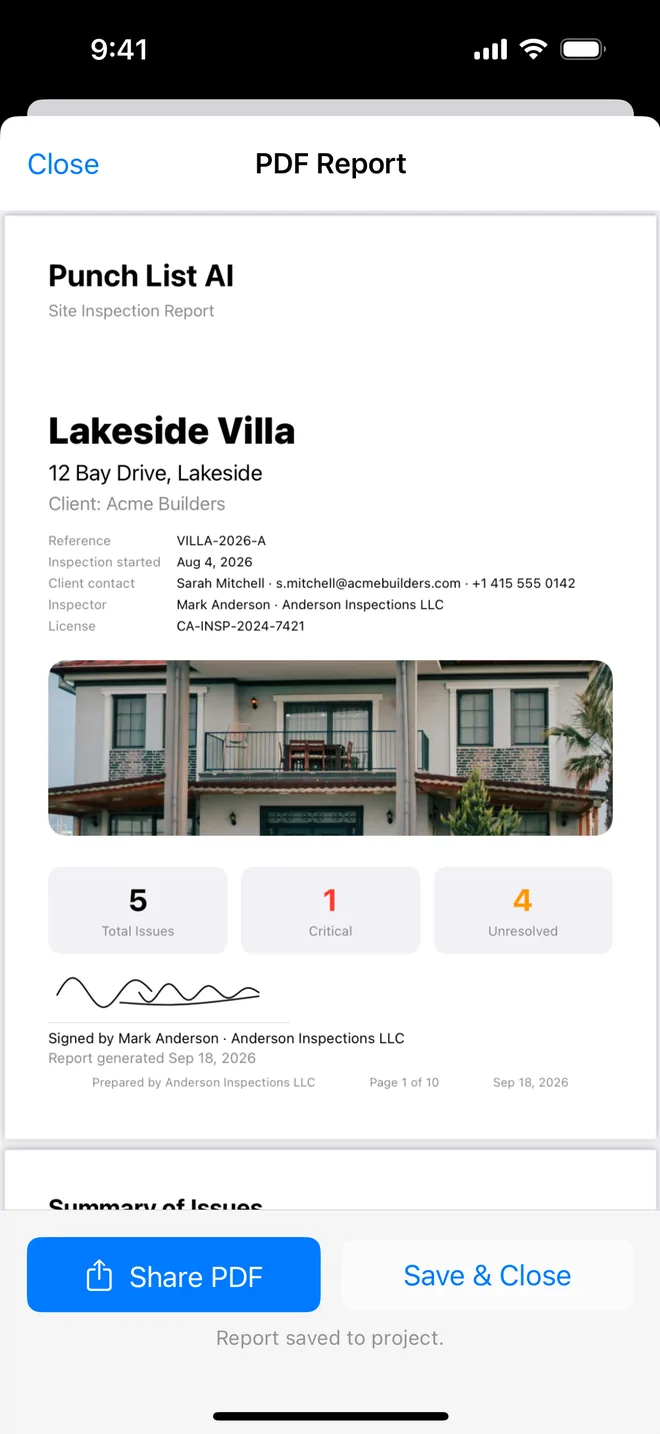
- The report: an itemised, photographed schedule of every defect with a location and a recommendation, normally issued as a PDF within one to three working days. Most firms will also send it to the developer on your behalf.
What it does not include, and should say it does not: testing of electrical or gas installations (that is the installer's certificate), anything behind finishes, structural calculations, or an opinion on whether the house complies with the building regulations. A snagging inspector reports what is visible; the site inspection checklist is roughly the list they work from, and the defect field guide is what they are looking for.
What makes the price go up or down?
Size and layout. Bedrooms are the proxy every firm uses, because they track the number of windows, doors, sockets and wet rooms. A three-bedroom house with two bathrooms and an en-suite is more work than a four-bedroom house with one, and a good firm will ask.
Accreditation. RICS-regulated firms and chartered surveyors charge from about £320 for a flat and considerably more for a house. You are paying for professional indemnity cover, a complaints procedure and a report that carries more weight if the dispute escalates. Many excellent snaggers are not RICS members; the difference matters most if you expect a fight.
Location. London and the south-east run £50–£100 above the national figures. Rural areas can carry a travel charge instead.
Timing. Pre-completion inspections are sometimes priced slightly higher because access has to be arranged with the site manager and the visit can be cancelled at short notice. Some firms charge a small premium for weekends.
Extras. Thermal imaging (missing insulation, cold bridging, hidden leaks) adds £50–£150 and is worth it in winter on a house, less so on a flat in summer. Drone roof inspection adds a similar amount. A re-inspection to confirm the fixes is the extra most worth paying for and the one most people skip.
Age of the property. Snagging is priced for new homes. A property in its second year, with the developer's defects period about to close, is often charged at the same rate but takes longer, because the buyer now has a list of their own to add.
Is a snagging survey worth the money?
On a new home, almost always, and the arithmetic is not close. The Home Builders Federation's own customer survey finds that 93.7% of new-build buyers report snags or defects, and about a quarter report more than fifteen. Professional inspectors routinely list 50–150 items on a new house. Most are small: sealant, paint, doors, grout , but a few are the kind that cost real money if they are found after the two-year defects period instead of before it: a shower tray that is not sealed, a duct that ends in the loft, ground levels bridging the damp-proof course.
Set £350 against any one of those and the survey has paid for itself. Set it against the pattern, a documented, dated, photographed list handed to the developer while they are still obliged to fix it, and it is the cheapest insurance on the transaction. The fourteen snags found on almost every handover shows what a typical list looks like.
When it is not worth it: a property already well into its second year where the defects period is about to close and you have no leverage; a flat where the freeholder controls everything outside the front door and the inspection would be an hour of internal finishes; or a developer who has already agreed a full independent inspection as part of the sale. Even then, a checklist walk of your own costs nothing.
When should you book a snagging inspection?
Before completion, if you can. Developers registered under the New Homes Quality Code must allow a professional pre-completion inspection. That is the best moment: the defects are recorded before you own them, they are fixed before you move in, and the developer's incentive to finish is highest. Book two to three weeks before the expected completion date, and expect the visit to move if the build does.
In the first month, if you cannot. Some developers outside the code refuse access before completion. Book the inspection for the first two weeks of occupation, before furniture hides the walls and before anyone can suggest that the damage was yours.
Before the two-year point, at the latest. The builder's warranty obligation to fix defects runs for two years on most UK new homes. A second inspection at around twenty-two months, with your own list added, catches what has emerged since and gets it reported inside the window. It is the least-used and most valuable booking in the calendar.
What does the fee actually pay for?
This is the section for the inspector, and for the buyer who wants to know why £350 is not a lot of money.
A three-bedroom house takes three to five hours on site if every window, door, socket, tap and junction is checked, which is the job. Travel is an hour each way outside a city. The report: a hundred photographs sorted, placed, described, graded and laid out with a cover, a scope and a schedule, has historically taken another two to four hours at a desk. Add professional indemnity insurance, public liability, a moisture meter, a thermal camera if offered, a vehicle, the accreditation fees, and the unbilled time on the phone with the buyer and the site manager, and £350 for a nine-hour day is a modest wage for skilled work.
The number that has changed in the last two years is the report. Writing forty items from a camera roll at a desk is the part of the job that pays nothing and takes the evening; writing each item on site, at the moment of the photograph, with the location and a draft description already in place, turns a two-to-four-hour write-up into a half-hour edit and a same-day PDF. For a sole trader doing three inspections a week, that is a fourth inspection a week at the same price, or the same three with the evenings back. The inspection report guide covers what the document has to contain; the snagging inspectors' page shows the on-site version of that workflow, and the pricing page puts a number on it that is a small fraction of one inspection fee.
The price to the buyer has not fallen with that change, and it should not. What has changed is the turnaround , same-day reports are now the standard the better firms set, and the quality of the evidence, because a report written where the defect is has fewer wrong locations and fewer missing photographs than one written two days later from memory.
How do you choose a snagging inspector?
Price last. Ask for these first:
- A sample report. Every serious firm has one. Look for a scope section, a photograph for every item, a location you could walk to, a severity or priority, and a recommendation written as an action. If the sample is a list of one-line snags with no photographs, that is the report you will get.
- Insurance. Professional indemnity and public liability, with the amounts. No cover, no booking.
- Background. Site management, building control, surveying or a trade. Snagging is a judgement job; the inspector needs to have seen how houses go wrong.
- Time on site. Ask how long they will be there. Under two hours for a house is a walk-through, not an inspection.
- Turnaround and format. Same day to three days, as a PDF you can forward. Ask whether they send it to the developer for you and whether the report is written so the site manager can work from it.
- Re-inspection policy. What it costs, and whether closed items are photographed. The re-inspection is where the value lands; a firm that does not offer one is selling a list.
- What they will not do. A good inspector tells you the limits, no testing of services, no opinion on structure, no access to the roof, before you ask. One who claims to check everything has not thought about it.
Then compare prices between the two or three who pass, and pay the one whose sample report you would be happy to hand to a developer.
Can you snag a new build yourself?
Yes, and you should do it as well as, not instead of, the professional inspection. The site inspection checklist is a working list: walk every room with it in daylight, run every tap, open every window, photograph everything you are unsure about with something for scale, and write each item down where you are standing. You will find the paint, the sealant, the doors and the grout, and you will find them faster than you expect.
What you will usually miss is the expensive quarter of the list: the duct that stops in the loft, the shower tray that moves, the ground level that bridges the damp-proof course, the missing cavity tray that will show as a damp patch in February. Those are found by someone who has seen them before and knows where to look, which is what the fee buys. A buyer's list of forty finishing snags plus a professional's list of ten that matter is the combination that gets a new house finished.
Writing your own list?
Photograph each snag, get a draft description and severity to edit, and export the whole list as a dated, numbered PDF the site manager can work from. The free tier covers one full property.
Get the free appWhere these figures come from
Price ranges were checked in September 2026 against the published price lists and cost guides of national snagging firms and consumer bodies, including the HomeOwners Alliance snagging survey cost guide, MyBuilder's 2026 price guide and SnaggingFinder's 2026 survey of inspector pricing. The defect statistics are from the Home Builders Federation national new homes customer satisfaction survey as reported by the HomeOwners Alliance. Prices move; if you are reading this in 2027, add a few percent and check the firm's own page before you book.
Questions people ask
How much does a snagging survey cost?
Between £249 and £475 for most flats and houses in 2026, with one- and two-bedroom flats at the bottom of the range and four- and five-bedroom houses at the top. Larger or unusual properties are priced on application, from about £500. Expect to pay more for a RICS-regulated firm, for London, and for a package that includes a re-inspection.
Can the developer refuse a snagging inspection?
Not before completion if they are registered under the New Homes Quality Code: the code obliges them to allow a professional pre-completion inspection. Outside the code, some developers refuse access until you own the property. After completion nobody can stop you; you are inspecting your own home, and the builder's two-year obligation to fix defects applies either way.
How long does a snagging inspection take?
Two to three hours on site for a flat, three to five for a house, and the report usually follows within one to three working days. An inspector who is in and out in forty-five minutes has not checked every window, socket, tap and door, and the report will show it.
How many snags is normal on a new build?
Dozens. Snagging firms routinely report 50–150 items on a new house, most of them small finishing defects. A survey by the Home Builders Federation found that 93.7% of buyers reported snags and about a quarter reported more than fifteen. A very short list from a very fast inspection usually says more about the inspection than the house.
Does the builder have to fix the snags?
Yes, for defects reported within the builder's warranty period, which is two years on most new homes in the UK (the structural warranty runs longer but covers less). The snagging report is how you report them: dated, photographed, itemised, so that what was there on day one cannot later be blamed on you.