

Part of the guide: The Site Inspection Checklist to Run on Every Walkthrough
A non-conformance report (NCR) is the formal record that a piece of work, a material or a process does not meet a specified requirement: the drawings, the specification, a standard or the approved method. It is raised during construction, usually by the contractor's quality team or the client's engineer, and it stays open until the problem has been dealt with in a way the designer or engineer accepts: reworked, repaired, accepted as it is, or rejected and replaced.
It is not the same as a punch list item. A punch list collects incomplete or minor defective work near completion, and the fix is obvious. An NCR is for a departure from the requirements that needs a decision, often from someone other than the person who found it, and it leaves a traceable record of that decision.
When to raise an NCR, and when a punch list item is enough
- Raise an NCR when the work does not meet a stated requirement and the remedy is not simply "finish it": concrete with honeycombing or low test results, reinforcement placed out of tolerance and already cast, the wrong product installed, a fire-rated element built to an unapproved detail, a failed pressure test that has been covered up.
- A punch list item is enough when the work is incomplete, damaged or poorly finished and completing it to the specification is the obvious fix: a missing door stop, paint runs, a cracked tile.
- When in doubt, ask whether anyone other than the trade needs to approve the fix. If the engineer, the architect or the client has to agree, it is an NCR.

What goes in an NCR
Company forms differ, but a report that can be acted on and audited later contains:
- A reference number, from a register, never reused.
- Location: grid line, level, element, the way the drawings identify it.
- The requirement that is not met: drawing number and revision, specification clause, standard.
- What was found, measured where it can be, with photographs that locate it and show it.
- Immediate containment: what has been stopped, tagged or protected.
- Proposed disposition and who proposed it.
- Acceptance of the disposition by the engineer or designer, with any conditions.
- Cause, and what will stop it happening again.
- Verification and closure: who checked the corrected work, when, with the evidence.
The four dispositions
- Rework: bring the work back to the specified condition, for example by removing and rebuilding it. Once reworked and inspected, the element conforms.
- Repair: fix the work to an agreed method that makes it acceptable without meeting the original requirement to the letter. This needs the designer's acceptance, because the element now differs from what was designed.
- Use as is: accept the work unchanged, usually after the engineer has checked that it still does its job. This also needs written acceptance, and sometimes a change to the drawings.
- Reject: remove and replace, typically for materials or products that cannot be brought into conformance.
Who can accept a disposition is set by the contract and the quality plan. On most projects the contractor can propose, but only the client's engineer or the designer can accept a repair or a use as is.
Who raises it, and who closes it
Contractors raise NCRs against their own work and their subcontractors' work as part of their quality system; on projects run to ISO 9001, the control of nonconforming outputs is a requirement of that system. Clients and their engineers raise NCRs against the contractor when an inspection or a hold point fails. Either way, the NCR is closed by the party that raised it, after the corrected work has been verified. An NCR closed by the person who caused it is not closed.
A good register shows, at any time, how many NCRs are open, how old they are, and which trades and activities produce them. That last view is the useful one: a cluster of NCRs on the same activity is a process problem, and fixing the process is cheaper than fixing the work each time. See also hold points and witness points, where many NCRs start.
Common mistakes
- NCRs for everything. A register full of paint touch-ups hides the three NCRs that matter. Use the punch list for snags.
- No requirement quoted. "Poor workmanship" is an opinion. Quote the drawing, the clause or the tolerance.
- Repairing before the disposition is agreed. A repair nobody accepted is a second non-conformance.
- Closing on paper. Close only against evidence of the corrected work: an inspection, a test result, a photograph from the same position as the first.
What to do next
Agree with your client or engineer, at the start of the job, what is an NCR and what is a punch list item, who can accept each disposition, and where the register lives. Then raise NCRs early, quote the requirement, photograph the problem where it can be found again, and close only against evidence.
Punch List AI is a punch list tool rather than a full quality management system, but many teams use it for the evidence side of an NCR: a numbered item with the location, the photographs, the owner, a due date and the after photo when it is closed.
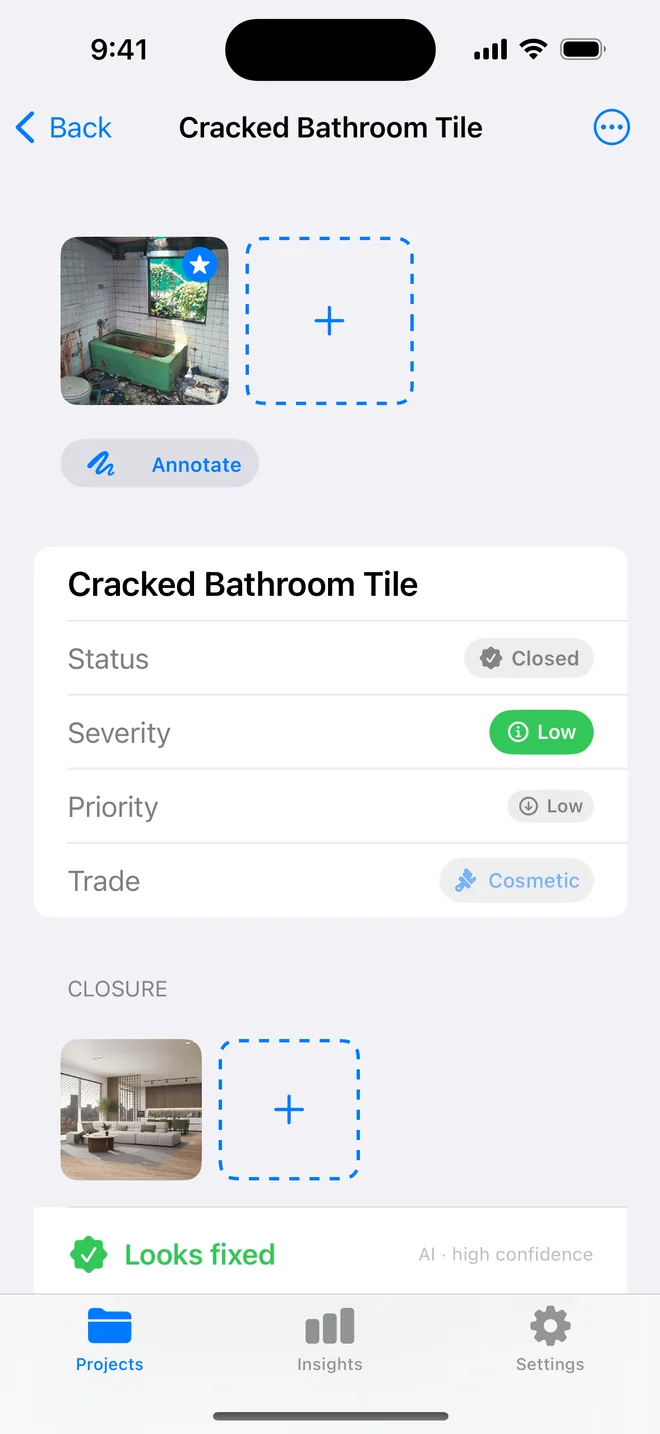
Record the evidence on your phone
Free to download. Numbered items with photos, owners and due dates, closed with an after photo.
Download on theApp StoreQuestions people ask
What is the difference between an NCR and a punch list?
An NCR records work that does not meet a requirement and needs an agreed decision on how to deal with it. A punch list records incomplete or minor defective work near completion where the fix is obvious.
Who can close an NCR?
The party that raised it, after the corrected work has been verified. Acceptance of a repair or a use-as-is disposition normally rests with the client's engineer or the designer.
Is an NCR required by law?
No. NCRs come from the contract and the quality system, for example one run to ISO 9001, not from legislation.