

Part of the guide: The Construction Defect Field Guide: 40 Defects by Trade, With Photos
Look down the vertical corner of any tiled shower that is more than a year old and there is a fair chance of a hairline crack running its full height, with a thin dark line of mould in it. It gets written up as "grout cracked, re-grout" on report after report, the contractor re-grouts it, and it is back by the next inspection. The grout was never the problem. The problem is what a corner does, and what grout cannot.
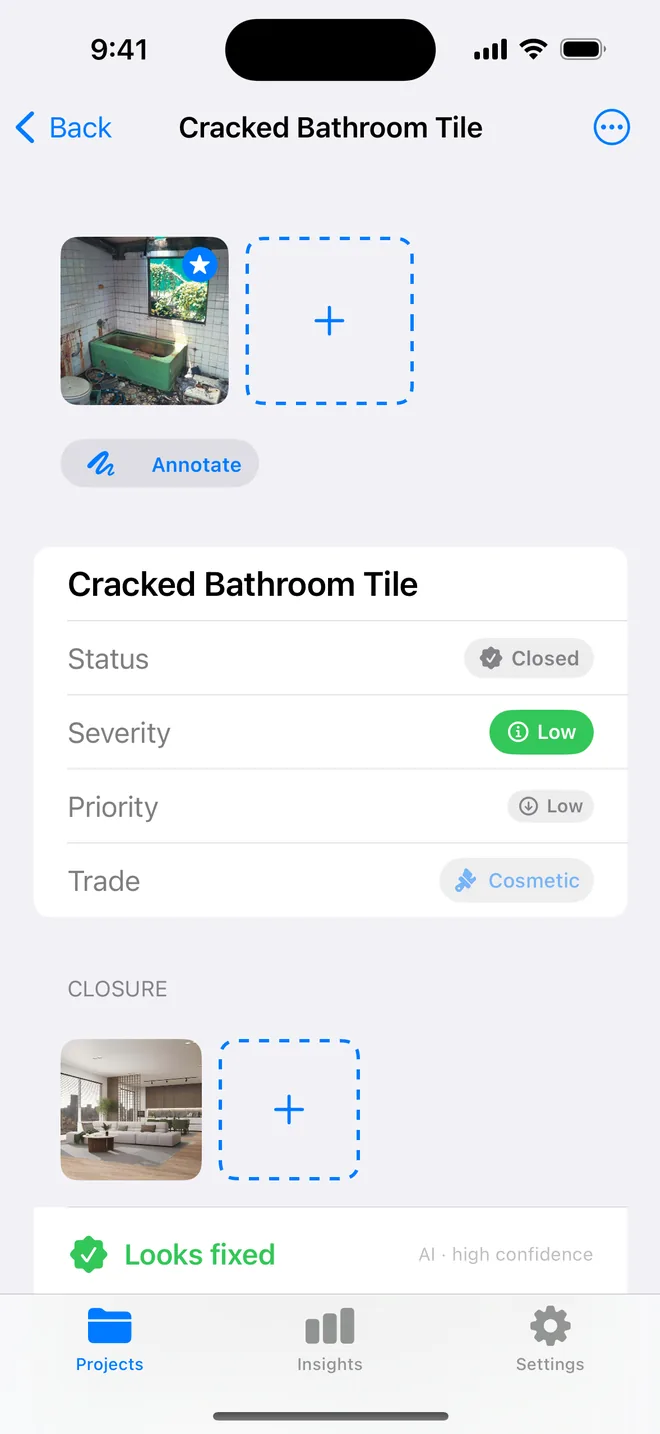
What does it look like?
A straight crack along the line where two tiled surfaces meet: the vertical internal corner of a shower or splashback, the junction between floor tiles and wall tiles, or the joint where tiling meets a bath, tray, basin or worktop. Early on it is a hairline that a fingernail catches in. Later the grout falls out in pieces and leaves an open channel. In a wet area the crack goes dark with mould within weeks, which is what usually gets it noticed.
The tell is the location. Grout that cracks in a straight line exactly along a corner, and nowhere else, has one cause. Grout that cracks in the middle of a flat wall or floor has different causes, thin or over-watered grout, or tiles that are hollow and moving, and belongs in a different item.
Why does grout crack at internal corners?
Cement grout is rigid: it sets hard and stretches almost not at all. Two walls meeting at a corner are two separate structures. They dry at different rates in the first year of a building, expand and contract differently with heat, and if one of them is a stud partition and the other is blockwork they move differently for the life of the house. A floor on timber joists deflects slightly every time someone stands on it, and the wall does not. Where the two meet, something has to give. If the joint is grout, the grout gives, on the first day the movement exceeds a fraction of a millimetre.

This is why every tiling standard requires a movement joint, a flexible sealant, not grout, at internal corners, at junctions with fittings, and at every change of plane. It is not an upgrade; it is the specification. A grouted corner is a tiler saving twenty minutes with a sealant gun, and the crack is the building collecting the debt with interest.
Less often the corner was sealed correctly but the sealant was applied over grout that had been packed into the joint first, so the bead had no depth and tore; or a grout marketed as "flexible" was used, which tolerates slightly more movement than standard grout and still far less than a corner needs.
Is it a snag or a leak?
In a dry room, a kitchen splashback, a tiled hallway, a cracked corner is cosmetic and low severity: it will not close up, it will collect dirt, and it should be raked out and sealed properly, but nothing is at risk while it waits.
In a wet room it is a water path and the severity follows the water. A cracked vertical corner in a shower takes water behind the tiles every time it is used; an open joint at the tray or bath junction feeds the floor and the ceiling below. Medium at least, and high once there is any sign that water has arrived somewhere it should not be: mould spreading beyond the joint, hollow tiles either side of the corner, staining on the ceiling under the bathroom, a damp patch on the other side of the wall. The shower tray article covers the tray junction in detail, because it is the same failure with more water behind it.
The field guide lists this as item 19 and puts it next to sealant failure and lipping tiles; the three are usually found in the same room on the same visit.
How do you report it?
- Location: room, and which junction, vertical corner, wall-to-floor, wall-to-tray, tiles to worktop. A shower can have four grouted corners; number them or the contractor will fix one.
- Observation: that the joint is grout rather than sealant (grout is matt and gritty; silicone is smooth and slightly glossy), the length of the crack, and whether there is mould in it or grout missing.
- Consequence checked: tap the tiles either side of the corner and say whether any sound hollow; look at the ceiling below and the far side of the wall and say what was found, even if it was nothing.
- Severity: low in a dry room, medium in a wet room, high with any evidence of water having travelled.
- Action: rake out to full depth, clean, dry and replace with a sanitary silicone movement joint. Write "replace with sealant", not "re-grout"; the two words are the whole difference between a fix and a repeat visit.
The box at the end of this article is the full line, including the tap-test note. That note is what turns a one-line snag into a record: if the tiles are solid now and hollow at the re-inspection, the water got in between the two visits, and the report says when.
How to check a tiled room in two minutes
- Run a fingernail down every internal corner and along every junction with a fitting. It should slide on smooth sealant; if it catches in a gritty joint, that joint is grout.
- Look at the bottom of each vertical corner, where it meets the tray, bath or floor. That is where the crack starts and where the mould shows first.
- Tap the tiles either side of any cracked corner with a knuckle. A hollow note means water or movement has already broken the adhesive bond behind them.
- In a wet room, run the shower onto the corner for a minute and watch the joint.
- Check the ceiling below and the other side of the wall in raking light before you write the item, so the severity is a finding and not a guess.
It sits in the wet-room section of the site inspection checklist, alongside the tray junction and the sealant checks that share its cause.
What the fix should be
Rake out the grout from the corner to the full depth of the tile, not just the cracked surface. Clean and dry the joint; sealant on damp grout dust does not bond. Seal with a sanitary-grade silicone in a colour that matches the grout, tooled once to a smooth concave bead, and left to cure before the room is used. If the tiles beside the corner were hollow, that is a separate item, lift, re-bed and re-tile: and it must come first, because sealing a corner between loose tiles seals nothing.
What not to accept: grout over the crack, sealant over the grout, or "monitor". None of them addresses movement, and a corner that has cracked once has proved that it moves.
If you inspect bathrooms for a living, the home inspectors' page shows how the fingernail note, the tap-test result and the "replace with sealant" line go into the report from the shower tray, while you are still standing in it.
Questions people ask
Can I just regrout a cracked corner?
You can, and it will crack again, usually within a season, because the cause is that two surfaces are moving against each other and cement grout cannot stretch. The corner needs a flexible sealant, a sanitary silicone, not more grout. Regrouting a corner is the most common wrong fix in a bathroom.
Why is my new grout cracking already?
If it is at corners and junctions, because grout was used where a movement joint was required; that shows within months as the building dries. If it is across the middle of a wall or floor, the grout was mixed too wet, applied too thin, or the tiles beneath are hollow and moving. The location of the crack tells you which.
Should the corners of a tiled shower be grout or silicone?
Silicone, always: every internal corner, every junction between tiles and a bath, tray, basin or worktop, and every change of plane. Tiling standards (BS 5385 in the UK, and the equivalents elsewhere) call for a movement joint at all of these. Grout belongs between tiles on the same plane and nowhere else.
Is cracked grout covered by the builder's warranty?
Grout used at a corner instead of a sealant is a workmanship defect and is the builder's to correct during the defects period. Hairline cracks in grout across a flat wall are usually treated as maintenance. Photograph it, date it and put it in the snagging report; the argument is much shorter with a picture. When to book the inspection covers the timing.